
Carbon Monoxide Detector Calibration and Bump Testing: Frequency, Method and Cell Replacement
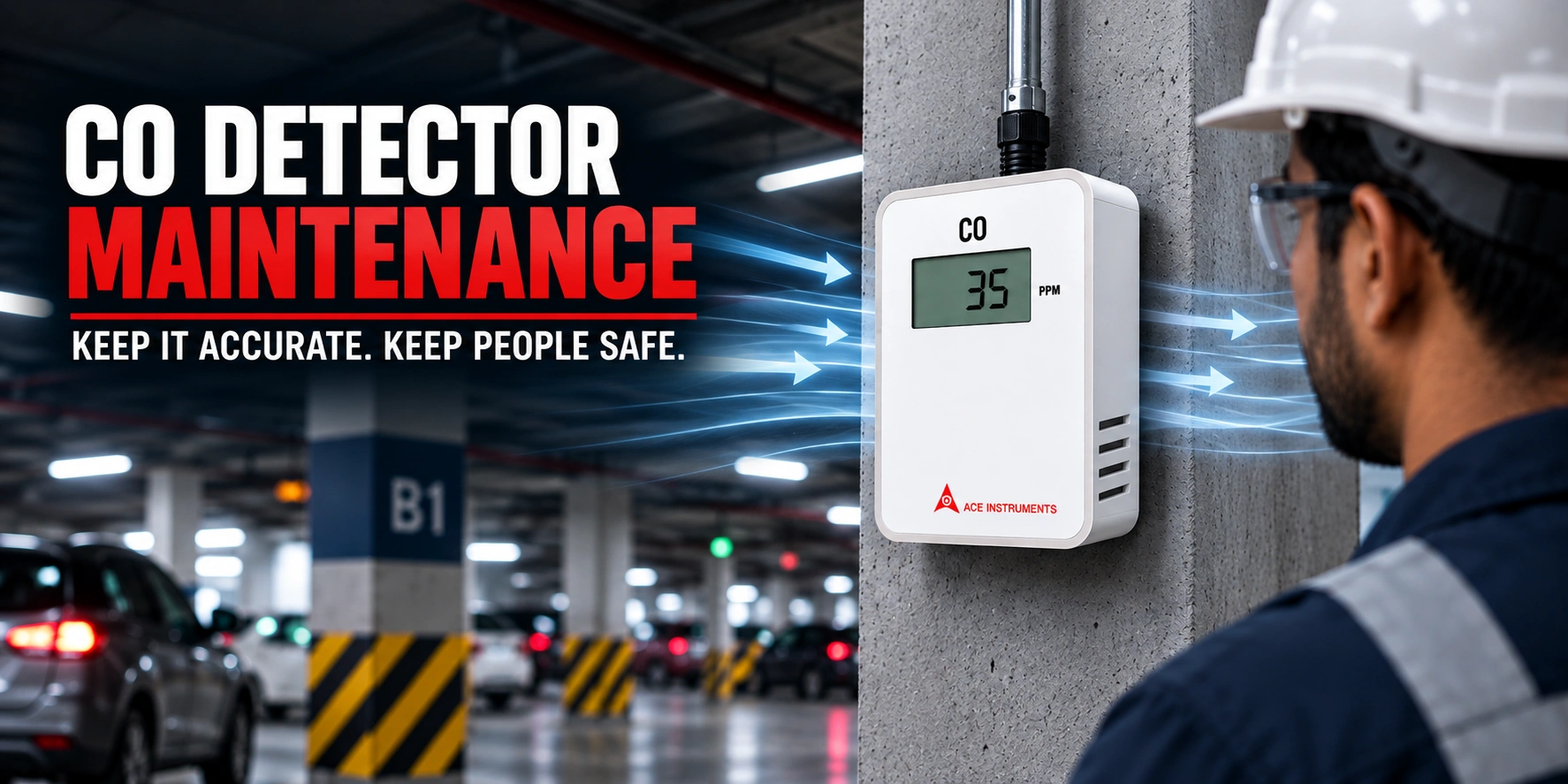
A fixed carbon monoxide detector is not a device that either works or does not. It is an instrument whose accuracy degrades gradually and silently, and the maintenance regime is what converts its output from a number into evidence.
That distinction matters because the failure mode is not a blank display. An electrochemical cell approaching end of life reports readings that are entirely plausible and progressively low. Nothing announces the problem. A system in that state produces a compliant-looking record of an exposure that was not compliant.
Bump test and calibration compared
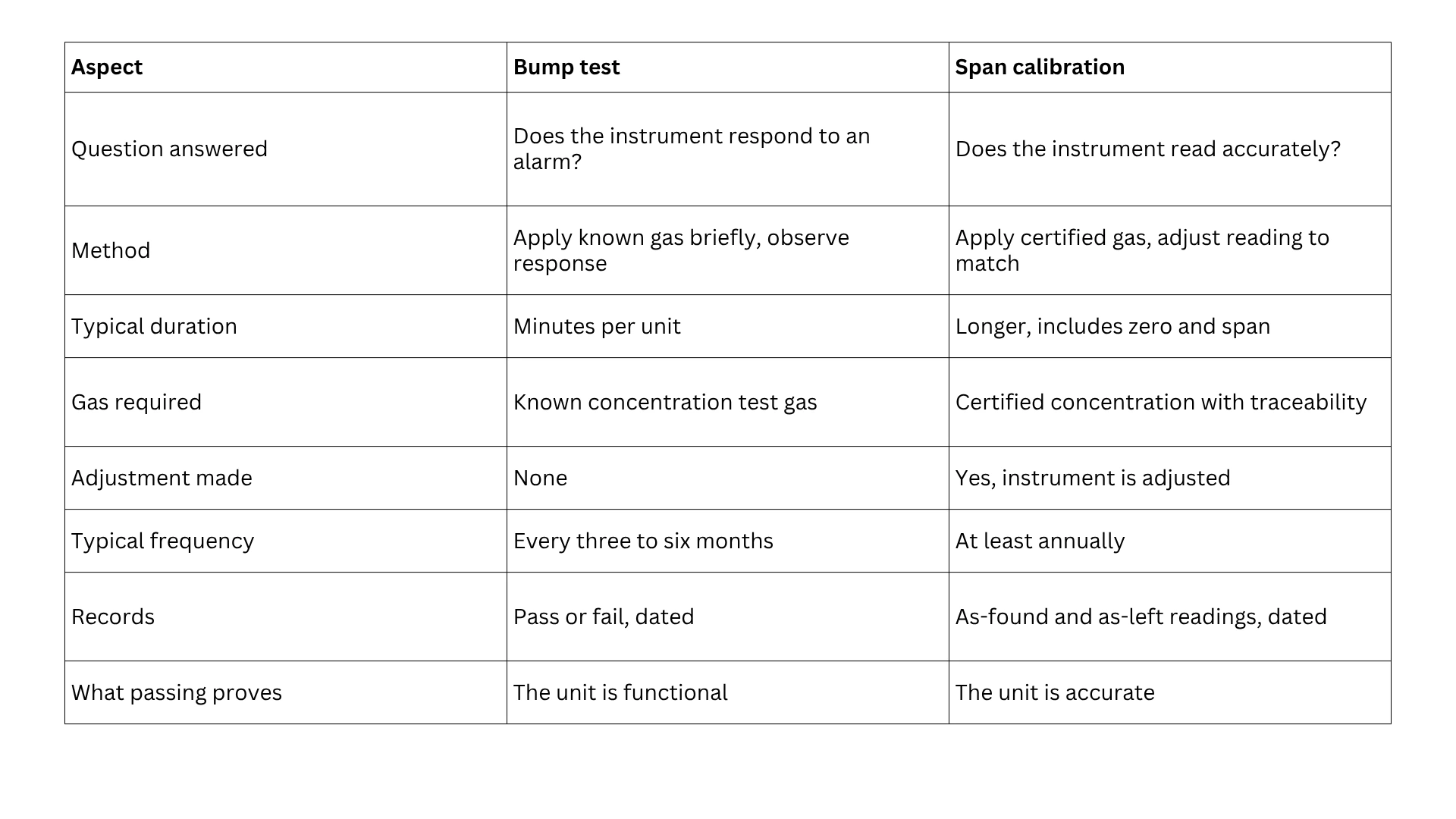
The final row is the one that gets misunderstood in the field. A bump test confirms the instrument is alive. It says almost nothing about whether the number it reports is right, because a cell that has drifted twenty percent low will still respond visibly to applied gas and will still pass a functional check.
Maintenance schedule
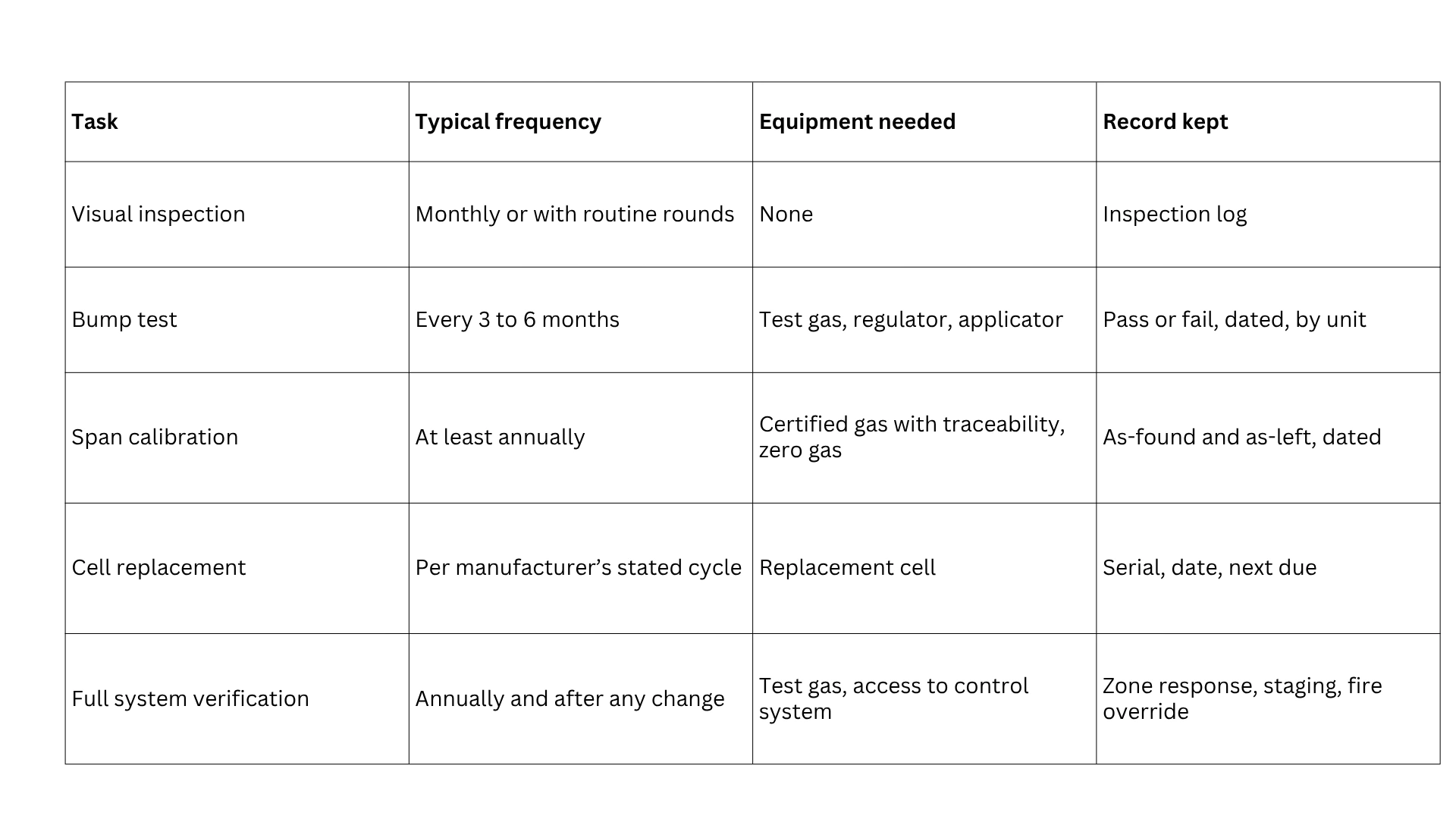
Frequencies here reflect common practice for fixed installations. The governing interval is whatever the instrument documentation states, shortened where the environment is severe. A car park in Indian summer conditions, an unconditioned warehouse or a plant room adjacent to an operating generator all justify more frequent verification.
Why the cell degrades
The degradation follows directly from how the measurement works. An electrochemical cell oxidises carbon monoxide at a working electrode and produces a current proportional to concentration. Three of the elements in that process are consumed or degraded in service: the electrolyte loses water to the atmosphere through the same diffusion barrier that admits gas, the electrode materials degrade over time, and every molecule measured is chemically converted. The mechanism is set out in full in how electrochemical detection works.
Three environmental conditions accelerate it:
- Sustained high temperature increases both electrolyte evaporation and electrode degradation
- Very low humidity draws water from the electrolyte faster than the cell can tolerate
- Repeated high-concentration exposure consumes electrode capacity faster than background monitoring
Because the loss is gradual, there is no point at which the instrument declares itself unfit. This is why cells are replaced on a defined cycle rather than run to failure, which means accepting an unknown period of under-reporting.
Cross-sensitivity, and why it is a design issue
An electrochemical carbon monoxide cell responds to other gases that oxidise at the working electrode by a similar pathway. Hydrogen is the most significant, and its contribution is not distinguishable from carbon monoxide in the output.
In most commercial installations this never arises. It becomes real wherever monitoring shares a space with lead-acid battery charging, which liberates hydrogen, or with hydrogen handling of any kind. Two environments in this cluster meet that description: warehouses with electric forklift charging areas and plant rooms containing generator starting batteries or UPS banks.
The wrong response is to raise the alarm setpoint until the nuisance alarms stop, which degrades the protection the system exists to provide. The right response is to separate the hazards in the design: monitor hydrogen with dedicated LEL detection and site carbon monoxide instruments away from the charging zone’s air path, so each instrument answers one question.
Other reducing gases including hydrogen sulphide, nitric oxide and some alcohols can also produce a response. Where such gases are present in the process, cell selection should account for them at specification stage.
Records are the deliverable
For most fixed installations, the purpose of calibration is not only that the instrument reads correctly. It is that the organisation can demonstrate the instrument read correctly across a defined period.
That distinction determines what a calibration record must contain. As-found readings before adjustment, because they establish the extent of drift across the interval and therefore the confidence attachable to the data already logged. As-left readings after adjustment. The certified gas concentration and its traceability. The date, the instrument identity and the technician.
An as-left-only record proves the instrument was accurate at the moment of calibration and says nothing about the twelve months preceding it. That is precisely the period an inspection or an incident investigation will ask about.
The same reasoning applies to the readings themselves. Demonstrating compliance with a time-weighted limit such as the OSHA 50 ppm eight-hour figure under 29 CFR 1910.1000 Table Z-1 requires continuous logged measurement across the period, and the calibration record is what makes that log admissible. The applicable thresholds are compared in the exposure limit guide.
Designing for maintainability
Most maintenance failures are designed in rather than caused later. An instrument requiring scaffolding, a permit or a shutdown to reach will not be serviced on schedule over a building’s life, whatever the maintenance plan says. Accessibility should therefore be a placement criterion alongside measurement representativeness, as covered in the mounting height and coverage guidance.
Instrument selection contributes too. A replaceable cell rather than a sealed unit, front access for calibration, and a clear indication of calibration due status all reduce the cost of doing the right thing.
Instrumentation and support
Ace Instruments manufactures fixed carbon monoxide instrumentation under the IAQ Detectors brand, with calibration and cell replacement intervals stated in the product documentation for each instrument. The AI-CO Carbon Monoxide Transmitter and duct-mounted AI-CO-D both use electrochemical detection with serviceable cells. Where instruments report to a building management system, calibration status and drift trends can be logged alongside the readings themselves, as covered in the guidance on BMS integration.
Ace Instruments has designed and manufactured indoor air quality instrumentation from its Hyderabad facility since 1991, with more than 1,000 installations worldwide. The IAQ Detectors range is CE certified and manufactured under an ISO 9001:2015 registered quality system, which governs the traceability of the calibration procedures supplied with each instrument. The complete range is available in the carbon monoxide category.
Frequently asked questions
How often should a carbon monoxide detector be calibrated?
Fixed carbon monoxide detectors are typically bump tested every three to six months and fully span calibrated at least annually, with the exact interval set by the instrument manufacturer, the severity of the environment and any applicable site or approval requirement. Harsh conditions such as high temperature, high humidity or heavy dust loading justify more frequent verification. Always follow the interval stated in the instrument documentation.
What is the difference between a bump test and a calibration?
A bump test applies a known gas concentration briefly to confirm the instrument responds and alarms, answering only whether the detector is alive. A calibration applies certified gas and adjusts the instrument so its reading matches the applied concentration, restoring measurement accuracy. A bump test is a functional check that takes minutes; a calibration is a metrological adjustment. Passing a bump test does not mean an instrument is reading accurately.
How long does an electrochemical carbon monoxide cell last?
Electrochemical carbon monoxide cells have a finite service life stated by the cell manufacturer, because the electrolyte and electrode materials are consumed and degraded in use. Sustained high temperature, very low humidity and repeated high-concentration exposure all shorten it. Cells should be replaced on the stated cycle rather than run until they fail a calibration, since degradation is gradual and produces plausible but progressively low readings.
Does hydrogen interfere with carbon monoxide detectors?
Yes. Hydrogen is the most significant cross-interferent for electrochemical carbon monoxide cells, because it oxidises at the working electrode by a similar pathway and produces a signal indistinguishable from carbon monoxide. This matters wherever monitoring shares a space with lead-acid battery charging or hydrogen handling. The correct response is to design for it during specification rather than tolerate recurring nuisance alarms.
Know the latest trends in IAQ solutions from the Ace Instruments team


Get inspired and learn more
Instruments that exceed your technical expectations
Comprehensive and customized IAQ solutions for all applications

