
Carbon Monoxide Monitoring in Warehouses and Loading Docks: Forklift Exhaust and Worker Exposure
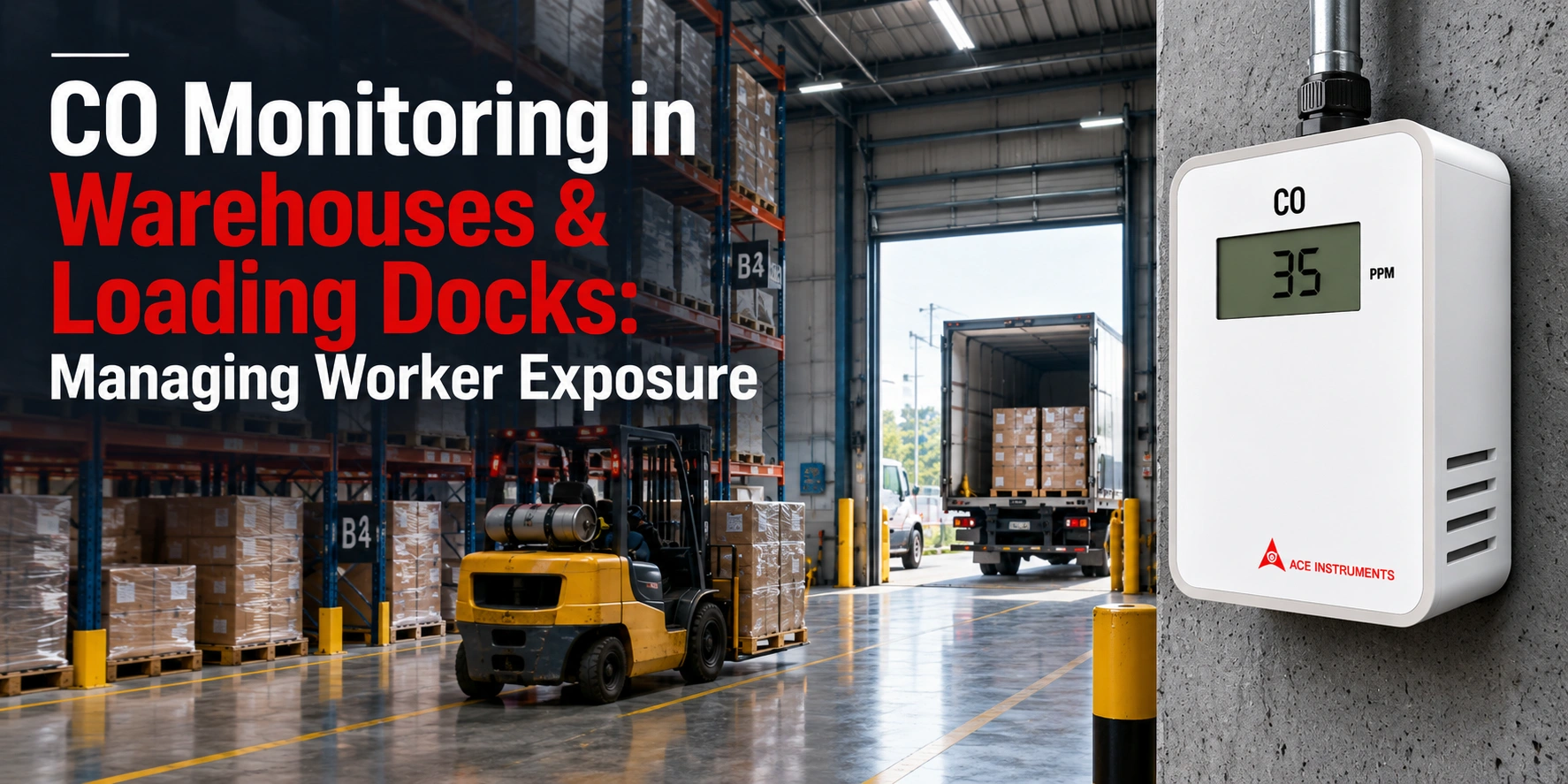
Carbon monoxide monitoring in warehouses addresses a different kind of risk from the one most people picture. There is rarely a dramatic release. Instead, LPG, propane and diesel forklifts emit steadily through a shift into a volume large enough that dilution keeps any instantaneous reading unremarkable, while the eight-hour time-weighted average climbs toward the 50 ppm OSHA limit under 29 CFR 1910.1000 Table Z-1.
The size of the building, which intuition suggests should make it safe, is what makes the problem invisible.
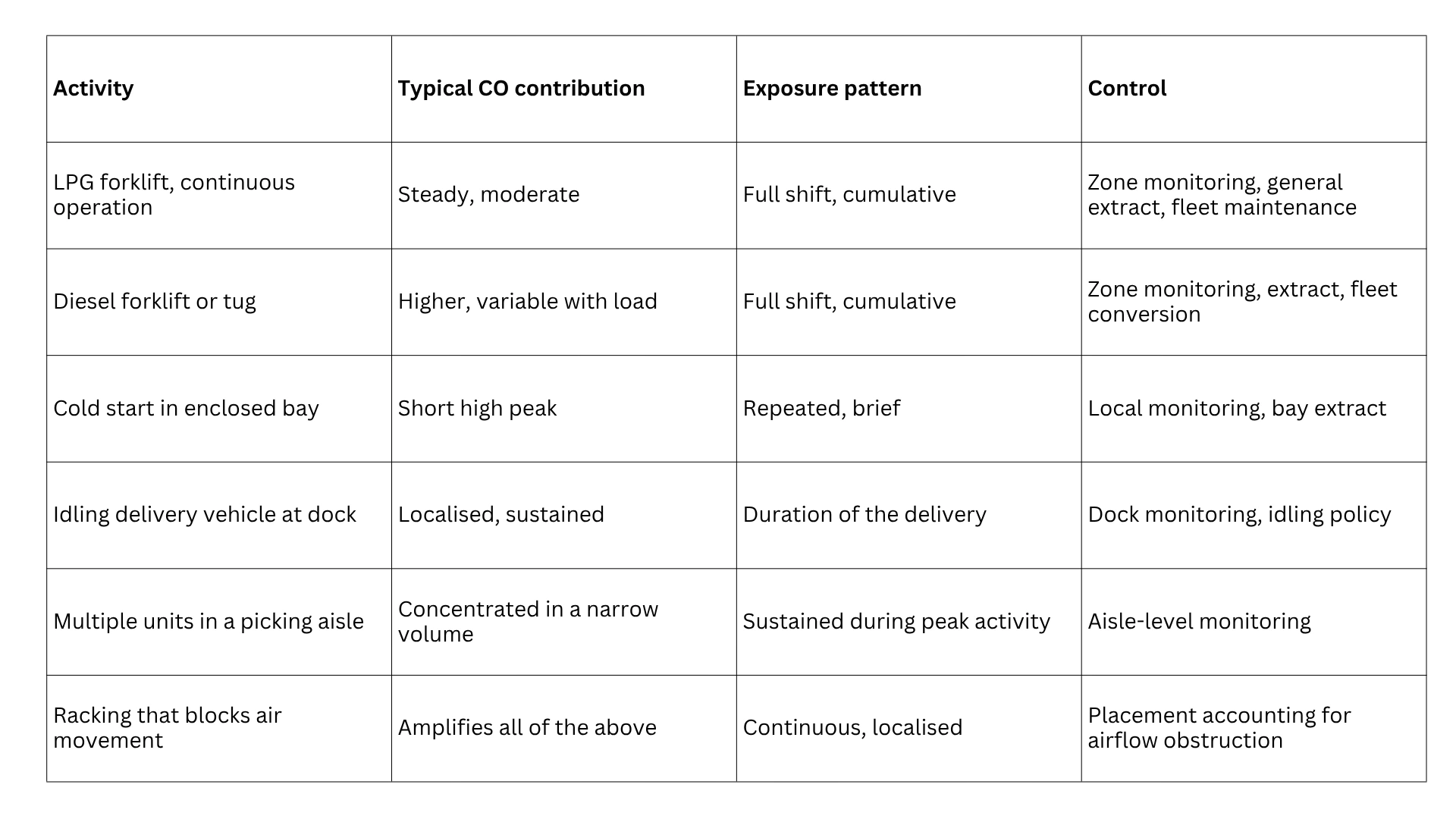
Exposure scenarios in warehouse operations
Time-weighted average versus instantaneous reading
The distinction between these two ways of expressing an exposure is the entire subject of this post.
An instantaneous reading tells you the concentration right now. A time-weighted average tells you the dose accumulated across a shift, and it is the basis on which occupational limits are written and enforcement is judged. Dose is concentration multiplied by time, and carbon monoxide accumulates in the bloodstream as carboxyhaemoglobin over a shift rather than being processed away between readings.
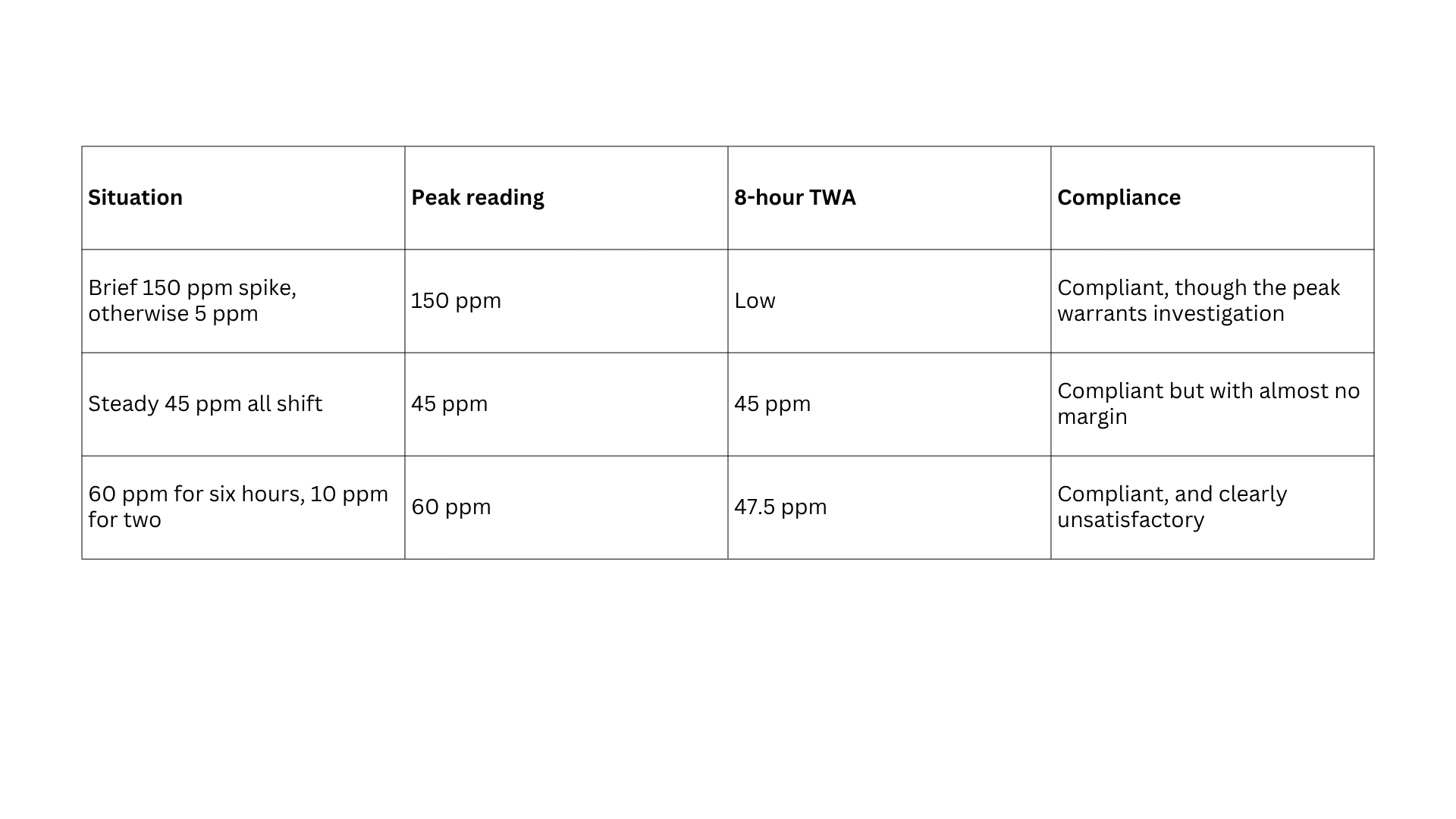
The middle and lower rows are the warehouse case. Nothing alarming ever appears on a handheld instrument during a spot check, and the shift-long exposure sits just under the enforceable limit with no margin for a fleet that degrades or a day that runs busier than usual.
Demonstrating compliance in this situation requires continuous logged measurement. A system that only alarms on a threshold cannot produce the evidence, because the number that matters is an average it never calculated. The full set of applicable thresholds is compared in the exposure limit guide.
Why loading docks need separate treatment
A loading dock behaves as a distinct environment even though it is physically continuous with the warehouse.
A partially open dock door creates a boundary. Air movement at the opening is governed by wind, by the pressure differential across the building and by the vehicle itself, and general warehouse extract has limited influence there. At the same time the opening admits exhaust from vehicles manoeuvring and idling outside.
The result is a zone that can carry a materially higher concentration than the warehouse it opens into, occupied by staff who spend a large fraction of their shift in exactly that position. Instruments positioned in the warehouse body will not represent it.
Vehicle idling policy is the most effective control, and monitoring is what makes it enforceable, by converting an instruction into a measured outcome.
Racking, airflow and the limits of dilution
Warehouse air is far less well mixed than the open floor area suggests. High-bay racking creates aisles that behave as partially enclosed channels, with restricted cross-flow and air movement dominated by the aisle direction.
This means a general extract rate calculated from building volume can be satisfied on paper while individual aisles remain poorly ventilated. Where forklift activity concentrates in a picking aisle, the local concentration can substantially exceed the building average.
Two implications for detector placement follow. Instruments should be positioned where activity concentrates rather than distributed evenly across the plan, and the racking layout should be treated as part of the ventilation geometry rather than as contents. The general principles are set out in the placement and coverage guidance.
Electric fleets change the picture without removing the requirement
Battery-electric forklifts emit no carbon monoxide, and a fully converted fleet substantially reduces the exposure this post describes. Three qualifications keep monitoring relevant.
Mixed fleets are the norm during transition, often for years, and delivery vehicles at the dock remain in internal combustion regardless of the internal fleet.
Battery charging introduces hydrogen. This is a flammability hazard addressed by LEL detection, and it is also a cross-interferent for electrochemical carbon monoxide cells, which respond to hydrogen by a similar oxidation pathway at the working electrode. A charging area adjacent to carbon monoxide monitoring is a specification issue to be designed for, as explained in how electrochemical detection works.
And monitoring often exists to satisfy an obligation that is written against the building rather than the fleet, in which case a change of vehicle does not change the requirement.
Instrument selection
Warehouse monitoring emphasises continuous logging over alarm response, because the compliance question is about an average rather than a peak. Selection criteria that follow:
- Continuous proportional output rather than threshold contacts, so shift averages can be reconstructed
- Stable low-end resolution, since the concentrations of interest sit between 10 ppm and 50 ppm
- Tolerance of ambient range, given that many warehouses are unconditioned
- Documented calibration interval, since a logged average is only evidence if the instrument held calibration across the period
That final point does more work than it appears to. An electrochemical cell drifts low as it ages, and a drifted instrument produces a compliant-looking record of an exposure that was not compliant. A documented bump testing and calibration schedule is part of the evidence, not an operating overhead.
The AI-CO Carbon Monoxide Transmitter from Ace Instruments provides continuous measurement for warehouse and loading dock zones under the IAQ Detectors brand. Where general air quality monitoring is also required across a large floor plate, the particulate matter range addresses diesel particulate alongside carbon monoxide. Integration for continuous logging is covered in the guidance on BMS integration, and the wider source picture in what causes carbon monoxide build-up in commercial buildings.
Ace Instruments has designed and manufactured indoor air quality instrumentation in Hyderabad since 1991, with more than 1,000 installations worldwide. The IAQ Detectors range is CE certified and manufactured under an ISO 9001:2015 registered quality system. The complete range is available in the carbon monoxide category.
Frequently asked questions
Do warehouses need carbon monoxide monitoring?
Warehouses operating LPG, propane or diesel forklifts need carbon monoxide monitoring because the exposure is cumulative across a shift rather than acute. A large floor volume dilutes emissions enough that no single reading appears alarming while the eight-hour time-weighted average approaches the 50 ppm OSHA limit under 29 CFR 1910.1000 Table Z-1. Battery-electric fleets substantially reduce but do not always eliminate the requirement.
How much carbon monoxide does an LPG forklift produce?
Output varies widely with engine condition, tuning, load and duty cycle, which is precisely why measurement rather than estimation is the basis for control. A well-maintained and correctly tuned LPG forklift emits substantially less carbon monoxide than a poorly maintained one, and emissions rise sharply under heavy load and during cold operation. Fixed monitoring captures the actual exposure the fleet produces in the actual building.
What is the OSHA carbon monoxide limit for warehouse workers?
The OSHA permissible exposure limit is 50 ppm as an eight-hour time-weighted average under 29 CFR 1910.1000 Table Z-1, and it applies to warehouse work as to general industry. The NIOSH recommended limit of 35 ppm and the ACGIH Threshold Limit Value of 25 ppm are lower health-based figures often adopted in corporate safety standards.
Where should carbon monoxide detectors go in a loading dock?
Place carbon monoxide detectors at a loading dock in the working area at breathing zone height, around 1.5 metres above floor level, close to where vehicles idle and staff operate rather than deep inside the warehouse. Dock areas need their own instruments because a partially open door creates local air movement that isolates the dock from general warehouse extract while admitting exhaust from vehicles outside.
Know the latest trends in IAQ solutions from the Ace Instruments team


Get inspired and learn more
Instruments that exceed your technical expectations
Comprehensive and customized IAQ solutions for all applications

