
Carbon Monoxide Detector Placement: Mounting Height, Spacing and Coverage per Unit
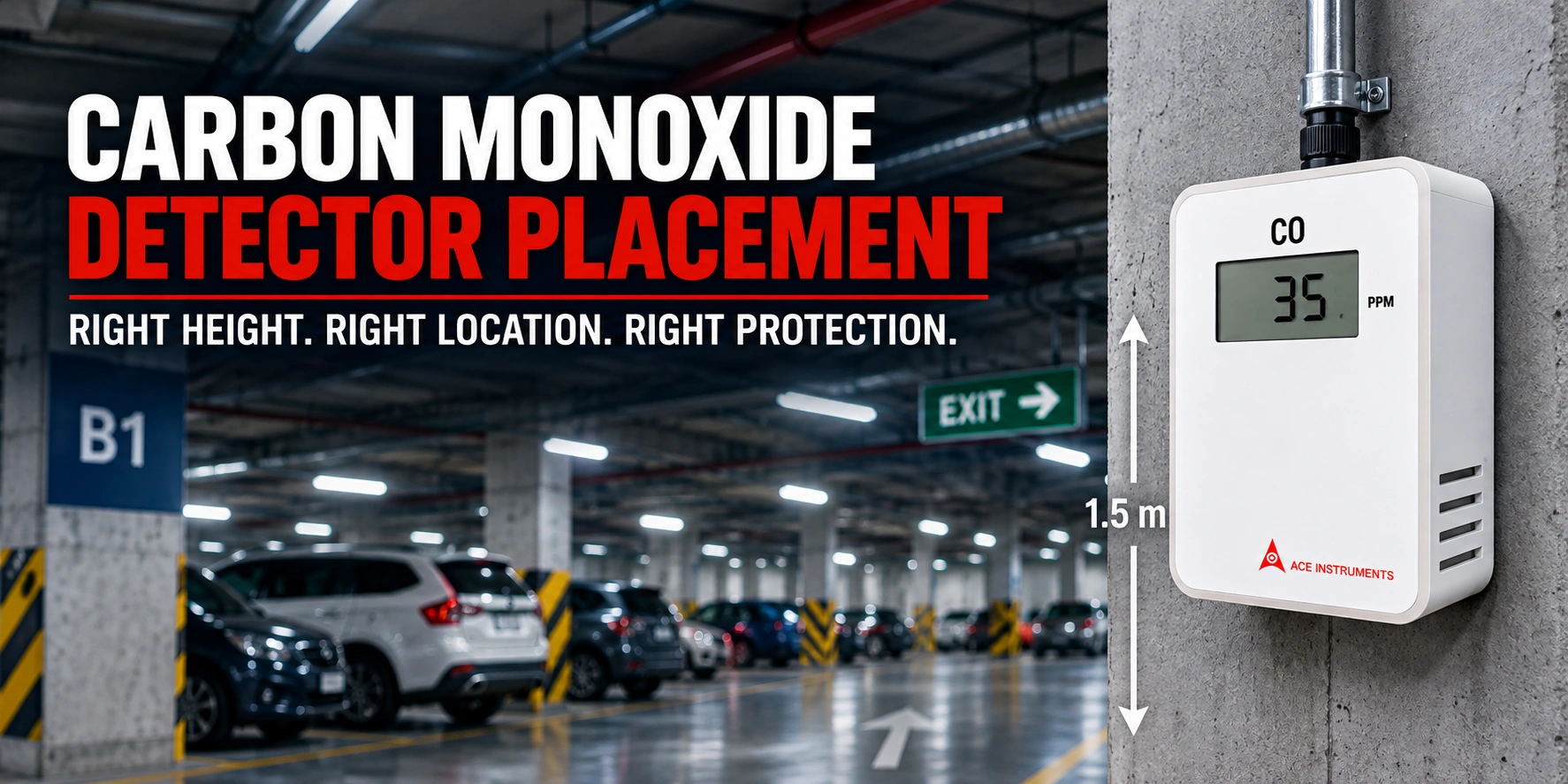
Carbon monoxide detectors in commercial and industrial spaces are mounted in the occupied breathing zone, typically around 1.5 metres above finished floor level, because carbon monoxide does not stratify. Its relative density is 0.967 relative to air, a difference of roughly three percent, which is far too small to overcome normal air movement.
That single physical fact governs almost every placement decision that follows, and it is the reason placement practice for carbon monoxide differs from practice for smoke, for refrigerants, or for heavier-than-air gases.
Mounting height and coverage by space type
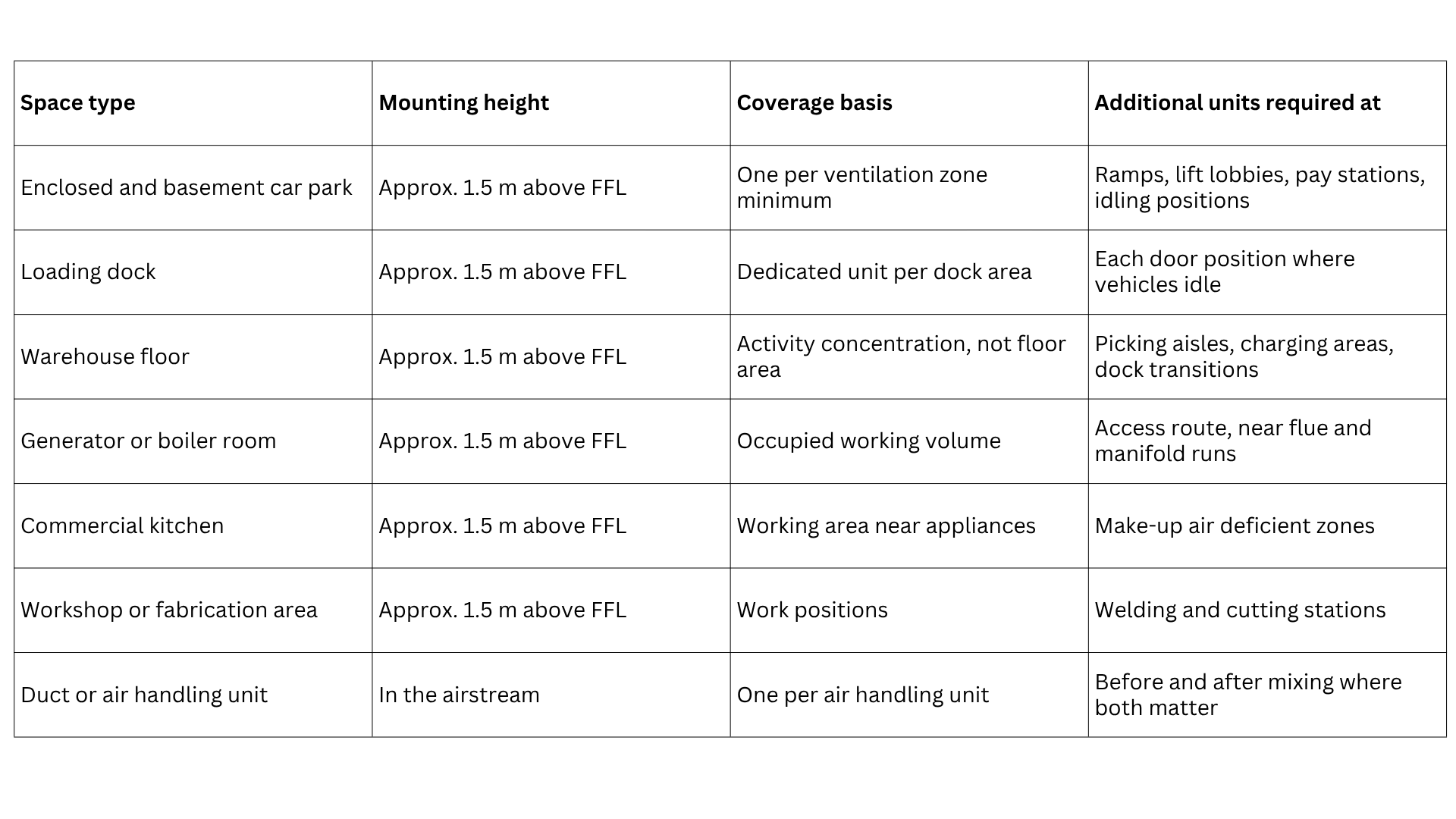
The heights are consistent because the physics is. What varies between space types is not where to mount but how many units are needed and where the additional ones go.
Why 1.5 metres, and why not the ceiling
Three arguments converge on breathing zone mounting.
The gas is there. Carbon monoxide mixes through the available volume rather than collecting at a level, so mounting height does not determine whether the instrument sees the gas at all. What it determines is timing and relevance.
It measures what people breathe. An occupational exposure limit describes what enters a person’s lungs. A breathing zone measurement is a direct measure of that quantity; a ceiling measurement is an inference about it, and one that becomes less reliable as ventilation patterns vary.
It detects sooner. Because the source is generally below ceiling level, a rising concentration reaches the breathing zone first. The margin is not large, but it runs in the safe direction.
Ceiling mounting for carbon monoxide is usually a habit carried over from smoke detection, where it is correct: smoke rises with the thermal plume of a fire. Carbon monoxide has no equivalent plume, so applying smoke practice produces a system that reads the wrong air, later. One exception applies: where the source is itself hot, such as a flue leak discharging above head height, a supplementary high-level unit can localise the leak faster. That is a diagnostic addition, not a substitute for a breathing zone instrument.
Placement exclusions
Where not to mount is as important as where to mount, and exclusions are the source of most commissioning problems.
- Not within the immediate influence of an exact grille. The instrument sits in air already being removed and reads artificially low, which holds ventilation down exactly when it is needed.
- Not adjacent to a fresh air supply diffuser. Same failure, opposite cause: the instrument reads incoming clean air rather than the occupied volume.
- Not in the direct discharge path of a jet fan. High velocity affects reading stability, and the air at that point is not representative of the zone.
- Not in dead corners with no air movement. The instrument reads a stagnant pocket that no occupant uses, and responds slowly to changes elsewhere.
- Not behind obstructions. Racking, plant, stacked pallets and partitions block the air movement the instrument depends on.
- Not where it cannot be reached. Every instrument requires periodic bump testing and calibration, and an inaccessible unit will not receive it.
That last exclusion causes more real-world failures than any of the others. A perfectly positioned instrument that requires scaffolding to service will, over a building’s life, quietly stop being serviced.
How many units: coverage as a function of airflow
No single code prescribes a coverage figure per unit. EN 50545-1, the European standard for car park gas detection apparatus, explicitly does not give guidance on the installation of a gas detection system, and national codes address ventilation provision rather than instrument density.
What determines coverage in practice is air movement, and three factors modify it.
Ventilation zoning sets the floor. Every independently controlled fan zone needs at least one instrument measuring the volume that zone serves. An instrument controlling a zone it does not measure is worse than no instrument, because it produces confident and incorrect control. This principle is developed in the basement car park design guide.
Obstruction reduces effective coverage sharply. An open car park deck and a compartmented basement of the same floor area do not require the same number of units. Structural downstands, compartment walls, high-bay racking and dense plants all restrict cross-flow, and each restricted sub-volume behaves as its own zone whether or not it was designed as one.
Source concentration pulls units toward activity. Even coverage across a plan is rarely optimal. Ramps, idling positions, picking aisles and dock doors generate disproportionate emissions and warrant instruments regardless of the geometric layout.
The practical method is to start from the ventilation zone count, add units at identified source concentrations, then add units wherever an obstruction creates a sub-volume that no existing instrument represents.
Duct mounting is a different problem
Instruments mounted in an air handling system follow different rules, because the objective changes from measuring occupied air to measuring distributed air.
The probe must sit in fully developed, well-mixed flow, downstream of bends, dampers, filter banks and junctions, and must reach into the airstream rather than sampling boundary-layer air near the duct wall. Position relative to the mixing point determines what the reading means. The detail is covered in why monitor carbon monoxide in HVAC ducts.
Verifying placement at commissioning
Placement is a hypothesis about where the air is representative, and commissioning is where it gets tested. Applying gas at the instrument confirms the unit responds and the correct zone acts, but not that the unit is in the right place. That requires measuring at the locations the instrument is meant to protect, with ventilation running, and confirming it sees the change within an acceptable time. Where an instrument responds slowly to a source within its nominal coverage, the placement is wrong rather than the instrument, and moving it is far cheaper at commissioning than after handover.
Instrument selection and placement together
Some placement constraints are eased by instrument choice. A unit with a stable reading across a wide air velocity range tolerates positions closer to airflow features. A unit with a replaceable cell and front access can be serviced in positions where a sealed unit could not.
The AI-CO Carbon Monoxide Transmitter from Ace Instruments, supplied under the IAQ Detectors brand, is designed for wall mounting in the breathing zone across car parks, plant rooms, warehouses and workshops, and the AI-CO-D Duct Carbon Monoxide Transmitter covers in-duct measurement. Both use electrochemical detection, whose behaviour under varying temperature, humidity and air velocity is explained in how electrochemical detection works. The concentrations these instruments are judged against are set out in the carbon monoxide exposure reference, and procurement benchmarks in the guide to EN 50545-1.
Ace Instruments has designed and manufactured indoor air quality instrumentation from its Hyderabad facility since 1991, with over 1,000 installations worldwide. The IAQ Detectors range is CE certified and manufactured under an ISO 9001:2015 registered quality system. The complete range is available in the carbon monoxide category.
Frequently asked questions
At what height should a carbon monoxide detector be mounted?
Commercial carbon monoxide detectors are mounted in the occupied breathing zone, typically around 1.5 metres above finished floor level. Carbon monoxide has a relative density of 0.967 relative to air, close enough to neutral that it mixes through the available volume rather than rising or settling. Breathing zone mounting measures the air occupants actually inhale and detects a rising concentration sooner than ceiling mounting.
Does carbon monoxide rise or sink?
Carbon monoxide neither rises nor sinks appreciably. Its relative density is 0.967 compared with air, a difference of about three percent, which is far too small to drive meaningful stratification against normal air movement, thermal currents and mechanical ventilation. In practice carbon monoxide mixes through the whole volume of a space, which is why there is no single height at which it concentrates.
How much area does one carbon monoxide detector cover?
Coverage per unit is determined by airflow and zoning rather than by a fixed area figure. In open car park areas one instrument per ventilation zone is the starting point, with additional units at ramps, idling positions and pedestrian routes. Obstructions such as high-bay racking, compartment walls and structural downstands reduce effective coverage substantially, because they restrict the air movement the instrument depends on.
Should carbon monoxide detectors be mounted on the ceiling?
No. Ceiling mounting is appropriate for smoke, which rises with the thermal plume of a fire, but not for carbon monoxide, which does not stratify. A ceiling mounted carbon monoxide detector reads air that occupants are not breathing and detects a rising concentration later than a breathing zone unit, with no compensating advantage. Ceiling mounting is a common error carried over from smoke detection practice.
Know the latest trends in IAQ solutions from the Ace Instruments team


Get inspired and learn more
Instruments that exceed your technical expectations
Comprehensive and customized IAQ solutions for all applications

