


Product Description
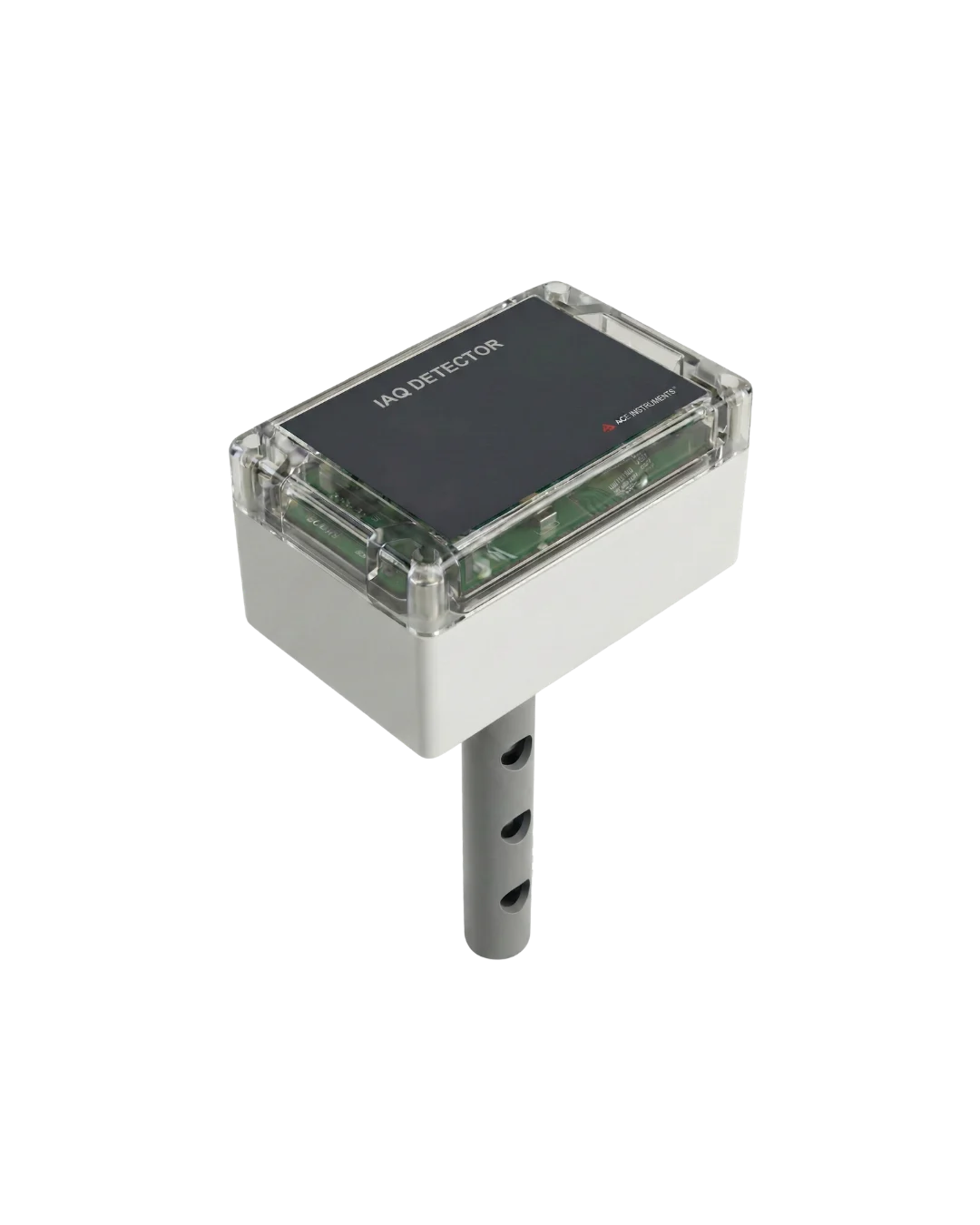
The Ace Instruments duct mounted indoor air quality (IAQ) sensor is designed for installation in green buildings where air is sampled from the HVAC ducts (return air/supply air duct) to enable total IAQ insight. The device is designed to give an overview of the critical IAQ parameters: Particulate Matter PM2.5, Particulate Matter PM10, Volatile Organic Compounds (VOC), Temperature and Humidity.
The device comes equipped with RS-485 Modbus communication, allowing for full visbility over building management systems. The AI-IAQ-D duct mounted indoor air quality series is designed to solve the critical problem of demand controlled ventilation by providing insights into filter clogging status (particulate matter readings), prevailing thermal comfort (temperature & humidity readings) and alerts regarding high VOC content. Facility managers in commercial buildings can proactively manage air quality through early identification of issues, harnessing the power of strategically placed duct mounted indoor air quality sensors.
With placement in return air ducts, the AI-IAQ-D represents the quality of the air being supplied to the occupants in real time. Through insight into a wide variety of IAQ parameters, the duct mounted air quality monitor enables the implementation of a demand controlled ventilation system that takes into account a more comprehensive picture of air quality. The DCV can introduce fresh air based on inputs for fine particulates/dust in the air, VOCs from chemicals/fragrances/smells, and humidity control. This enhances energy savings while optimizing air flow in areas that have reasons other than high occupancy to have fresh air introduced.
The AI-IAQ series is designed to support users in meeting a range of regulatory requirements, including: LEED, WELL, ASHRAE 62.1, Estidima, Mostadam, GRIHA, BREEAM, NABERS, Green Star, CASBEE, Green Mark.
What It Monitors
The transmitter continuously tracks five key parameters within the airstream:
- PM2.5: Fine particulate matter, an early indicator of filter degradation or outdoor pollution infiltration
- PM10: Coarser dust particles, useful for detecting filter bypass or contamination events
- VOC: Chemical off-gassing or contamination entering the ductwork from outdoor air or system components
- Temperature: Confirms conditioned air is reaching the correct temperature as it moves through the duct
- Humidity: Tracks moisture levels in the airstream, relevant to comfort, mold risk, and HVAC performance
How Duct IAQ Monitoring Protects Occupants
By monitoring air quality in the ductwork, this transmitter detects contamination such as filter failures (PM spike), outdoor pollution events (PM/VOC), or HVAC system faults, before affected air reaches occupied spaces. Room monitors detect problems after they reach occupants. Duct monitors detect them at source, in the HVAC system itself. This distinction matters most in environments where early detection can prevent contaminated air from circulating widely, allowing facility teams to respond at the AHU level rather than after occupants have already been exposed.
Features
- Multi-parameter IAQ monitoring: The duct mounted indoor air quality transmitter consolidates key indoor air quality parameters in one device (PM2.5, PM10, VOC, Temperature, Humidity) providing well-rounded IAQ insight to users and replacing the need for multiple sensors for individual parameters.
- RS-485 Modbus communication: To offer ease of connectivity and powerful insights, the AI-IAQ-D connects to your BMS system over RS485 Modbus communication. Data is available 24x7 on BMS systems and can be processed for proactive IAQ maintenance.
- Reliable on-device air sampling: To ensure precise readings, this device employs a probe inserted directly into the HVAC duct that leverages the Venturi effect to circulate air samples. Air is forced through intake vents, directed internally across the IAQ sensor for analysis, and then expelled through exhaust vents on the opposite side, creating a continuous and accurate sampling loop.
- Durable ABS plastic duct mounting enclosure: The sensor is suited to withstand the working conditions in HVAC ducts with durable ABS material used for the enclosure and the probe attachment. A duct mounting bracket is provided for reliable and secure mounting onto HVAC duct systems.
Applications
The Duct IAQ Transmitter is suited to environments where early, source-level detection is critical:
AHU Supply Air Monitoring
- Places air quality sensing directly at the AHU, monitoring conditioned air before it's distributed to occupied zones
- Detects filter degradation or contamination early, since PM and VOC spikes show up at the source rather than downstream
- Supports predictive maintenance scheduling by trending particulate and VOC data over time
Multi-Zone Commercial HVAC Systems
- Provides centralized visibility into air quality across shared ductwork feeding multiple building zones
- Helps isolate whether an air quality issue originates from a single zone or the central HVAC supply
- Reduces the need for separate room-level sensors in every zone by monitoring at the duct level
Hospitals
- Supports infection control by detecting particulate and VOC contamination in ventilation air before it reaches patient areas
- Helps maintain the air quality standards required across wards, operating theatres, and critical care zones
- Enables early alerts for filtration issues in environments where clean air delivery is safety-critical
Cleanroom Environments
- Verifies that filtration and air handling systems are maintaining required particulate control at the source
- Detects filter breakthrough or contamination events before they compromise cleanroom classification
- Supports continuous compliance monitoring for facilities held to strict air cleanliness standards
Pharmaceutical Facilities
- Helps ensure HVAC-supplied air meets the particulate and VOC control standards required for manufacturing and QA processes
- Detects contamination risks at the duct level, supporting GMP compliance and audit readiness
- Enables proactive filter maintenance, reducing risk of air quality deviations during production
BMS Integration
With RS485 Modbus communication, the transmitter integrates directly into a Building Management System, allowing real-time PM, VOC, temperature, and humidity data to feed into existing HVAC control logic. This enables automated responses, such as filter change alerts, increased outdoor air intake, or AHU fault flagging, based on conditions detected inside the ductwork itself, before those conditions affect anyone in the building.
Specifications
Gain insight into your IAQ solution and know technical specifications
FAQs
1. What is the AI-IAQ-D Duct Indoor Air Quality Transmitter?
The AI-IAQ-D is a duct-mounted indoor air quality transmitter designed to continuously monitor air quality inside HVAC ducts and Air Handling Units (AHUs). It measures multiple environmental parameters in real time and transmits the data to Building Management Systems (BMS), PLCs, or SCADA systems for intelligent ventilation and air quality management.
2. Why monitor indoor air quality inside HVAC ductwork rather than only in rooms?
Monitoring inside ductwork allows early detection of air quality issues before they reach occupied spaces. If an air filter fails, outdoor particulate levels increase, or VOC contamination enters the HVAC system, the AI-IAQ-D detects the problem at the source and immediately reports it to the BMS. This enables corrective action before contaminated air is distributed throughout the building.
3. What parameters does the duct IAQ transmitter measure?
The AI-IAQ-D simultaneously measures five critical indoor air quality parameters:
- PM2.5 (Fine Particulate Matter)
- PM10 (Coarse Particulate Matter)
- Total Volatile Organic Compounds (TVOC)
- Temperature
- Relative Humidity
All measured values are transmitted through RS-485 Modbus for integration with Building Management Systems and HVAC automation.
4. Where is the AI-IAQ-D commonly installed?
The transmitter is ideal for:
- Air Handling Units (AHUs)
- HVAC supply air ducts
- Return air ducts
- Fresh air intake ducts
- Commercial buildings
- Hospitals
- Pharmaceutical facilities
- Laboratories
- Data centers
- Office buildings
- Shopping malls
- Airports
- Educational institutions
5. Why should indoor air quality be monitored inside HVAC ducts?
Monitoring IAQ inside HVAC ducts helps identify contamination before conditioned air reaches occupants. This improves indoor air quality, supports healthier buildings, protects HVAC equipment, and enables more efficient ventilation control.
6. Can the AI-IAQ-D detect filter failures?
Yes. A sudden increase in PM2.5 or PM10 downstream of an AHU filter typically indicates filter breakthrough, filter saturation, or bypass leakage. By trending particulate data through the BMS, facility managers can schedule filter replacement proactively before indoor air quality deteriorates.
7. Why monitor PM2.5 and PM10 in duct systems?
PM2.5 and PM10 represent airborne particulate pollutants such as dust, smoke, pollen, and combustion particles. Monitoring these parameters helps verify filtration performance and ensures clean air is supplied throughout the building.
8. What is TVOC, and why is it important?
Total Volatile Organic Compounds (TVOCs) are gases emitted from paints, furniture, adhesives, cleaning products, office equipment, and building materials. Elevated TVOC levels may affect occupant comfort and indoor air quality. Continuous monitoring enables early detection and corrective ventilation.
9. Can the transmitter be integrated with a Building Management System (BMS)?
Yes. The AI-IAQ-D supports RS-485 Modbus communication, allowing seamless integration with:
- Building Management Systems (BMS)
- PLCs
- SCADA systems
- HVAC automation controllers
- Energy Management Systems
10. Does the AI-IAQ-D help improve HVAC energy efficiency?
Yes. By continuously monitoring air quality inside HVAC ducts, ventilation systems can respond based on actual environmental conditions instead of fixed schedules. This demand-based approach helps optimize airflow and reduce unnecessary energy consumption.
11. Is the transmitter suitable for pharmaceutical and healthcare applications?
Yes. The AI-IAQ-D is widely used in pharmaceutical facilities, hospitals, laboratories, cleanrooms, and other critical environments where maintaining high indoor air quality is essential.
12. Does the AI-IAQ-D provide continuous monitoring?
Yes. It's designed for reliable 24/7 operation, continuously measuring indoor air quality parameters to support preventive maintenance and healthy building operation.
13. Does the transmitter have a local display?
Depending on the selected model, measurements can be viewed through connected Building Management Systems or optional local display configurations.
14. Does the transmitter require calibration?
Periodic calibration is recommended to maintain optimum measurement accuracy. Ace Instruments also provides calibration services and calibration certificates upon request.
15. Is installation easy?
Yes. The AI-IAQ-D is specifically designed for HVAC duct installation and can be easily mounted using standard duct mounting accessories.
16. What are the advantages of using a duct IAQ transmitter?
Key benefits include:
- Early detection of air quality problems
- Continuous monitoring of HVAC air quality
- Improved filtration performance monitoring
- Predictive filter maintenance
- Better occupant health and comfort
- Reduced HVAC operating costs
- Easy integration with BMS and automation systems
17. Who typically uses the AI-IAQ-D?
The transmitter is widely used by:
- HVAC contractors
- Building automation integrators
- Facility managers
- Hospital engineering teams
- Pharmaceutical QA departments
- Cleanroom consultants
- Mechanical consultants
- Industrial maintenance engineers
18. Why choose Ace Instruments?
Ace Instruments has been manufacturing environmental monitoring solutions since 1991. Customers trust Ace for:
- Accurate multi-parameter sensing
- Industrial-grade reliability
- Easy HVAC and BMS integration
- Custom-engineered solutions
- Calibration support
- Responsive technical assistance
- Proven installations across commercial, healthcare, pharmaceutical, and industrial facilities
19. Can the AI-IAQ-D be customized?
Yes. Depending on project requirements, the transmitter can be configured with:
- RS-485 Modbus communication
- Custom measurement ranges
- Project-specific calibration
- Application-specific configurations
- Integration with existing HVAC and BMS systems
20. How do I choose the right duct IAQ transmitter?
Our application engineers can recommend the most suitable AI-IAQ-D configuration based on your HVAC system design, monitoring objectives, communication requirements, building type, and indoor air quality goals.

