
How Electrochemical Carbon Monoxide Detectors Work: Mechanism, Accuracy and Cell Life
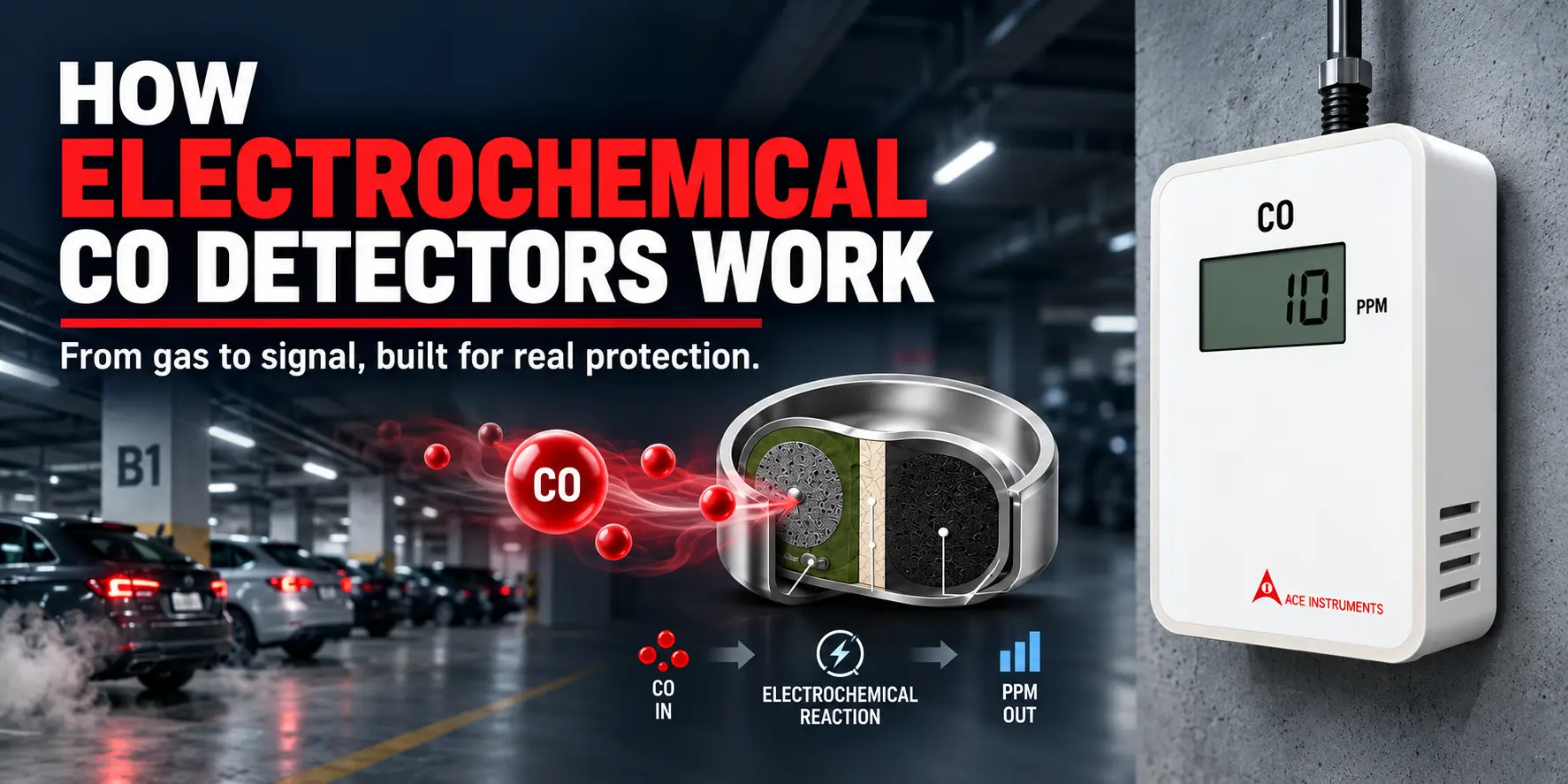
An electrochemical carbon monoxide detector works by oxidising carbon monoxide at a working electrode inside a sealed cell, releasing electrons and producing a current directly proportional to the gas concentration. The instrument amplifies that current, converts it to a ppm value, and outputs it as an analogue signal or a digital register.
That proportionality is the whole reason the technique dominates fixed carbon monoxide monitoring. It gives a linear response at the single-ppm resolution that commercial thresholds demand, without the calibration curve fitting that non-linear techniques require.
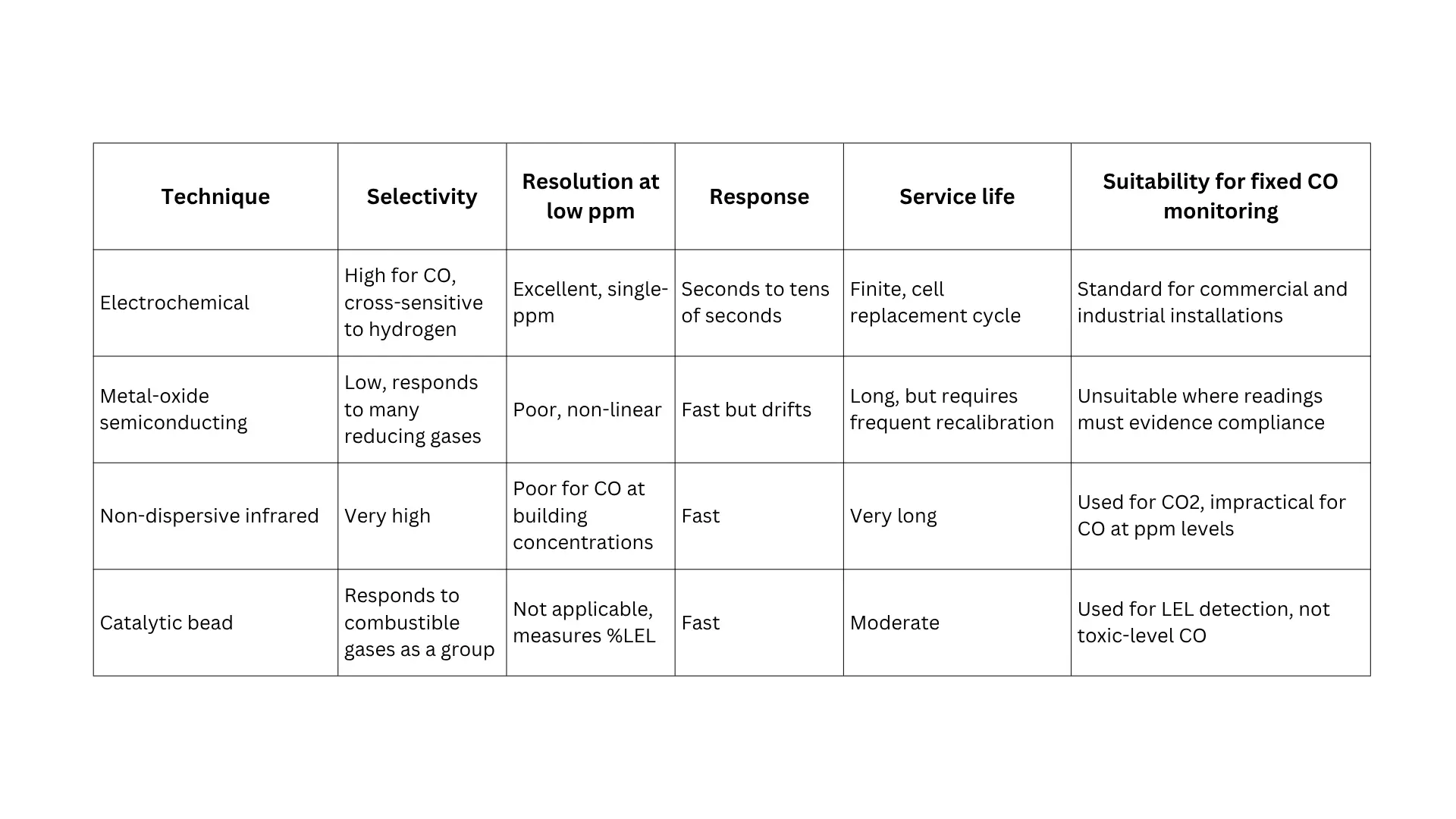
Detection technologies compared
The mechanism, step by step
The cell is a sealed assembly containing an electrolyte and at least two electrodes, with a controlled opening to the atmosphere being measured.
- Diffusion. Ambient air reaches the cell through a capillary or membrane diffusion barrier. This barrier is the single most important design element in the cell: by limiting the rate at which gas can enter, it makes the reaction rate dependent on the external concentration rather than on the cell chemistry, which is what makes the output linear.
- Oxidation at the working electrode. Carbon monoxide reaching the working electrode is oxidised to carbon dioxide. The reaction consumes water from the electrolyte and liberates electrons.
- Counter-reaction. At the counter electrode, oxygen from the ambient air is reduced, consuming the electrons released at the working electrode and completing the circuit. The cell requires ambient oxygen to function, which is why electrochemical detection is unsuitable for inert or oxygen-depleted atmospheres.
- Current measurement. The resulting current flows through the instrument’s measuring circuit. Because the diffusion barrier limits the reaction rate, this current is proportional to the carbon monoxide concentration outside the cell.
- Reference stabilisation. A three-electrode cell adds a reference electrode that holds the working electrode at a fixed potential regardless of load. This substantially improves stability and linearity, and is standard in instruments intended for compliance monitoring.
- Signal conditioning. The raw current, measured in the nanoamp to microamp range, is amplified, temperature-compensated and converted to a ppm value, then presented as a display reading and as a 4-20mA, 0-10V or RS-485 Modbus RTU output.
Why the cell has a finite life
Three of the six steps above consume something. The electrolyte loses water to the atmosphere through the same diffusion barrier that admits gas. The electrode materials degrade over time. And every molecule of carbon monoxide measured is chemically converted.
This is not a defect. It is inherent to a technique that works by reacting with the gas it measures, and it is the price paid for the linearity and low-end resolution that make electrochemical detection suitable in the first place. What it means practically is that the cell is a consumable with a defined replacement cycle, and that instrument selection should account for the cost and accessibility of that replacement across a building’s life.
Three ambient conditions accelerate the loss:
- Sustained high temperature increases both electrolyte evaporation and the rate of electrode degradation. Plant rooms and unconditioned car parks in Indian summer conditions are demanding environments in this respect.
- Very low humidity draws water out of the electrolyte faster than the cell can tolerate.
- Repeated high-concentration exposure consumes electrode capacity more quickly than normal background monitoring.
Because degradation is gradual rather than sudden, a cell approaching end of life produces readings that are plausible but progressively low. It does not announce itself. This is precisely why a documented bump testing and calibration schedule is not optional maintenance but the mechanism by which readings remain defensible.
Cross-sensitivity and where it matters
An electrochemical carbon monoxide cell responds to other gases that oxidise by a similar pathway at the working electrode. Hydrogen is the most significant of these, and the response is not distinguishable from carbon monoxide in the output signal.
In most commercial applications this is theoretical. It becomes real wherever carbon monoxide monitoring shares a space with lead-acid battery charging, which liberates hydrogen, or with hydrogen handling of any kind. In those environments the correct response is not to accept nuisance alarms but to specify appropriately, often by pairing carbon monoxide monitoring with dedicated LEL detection so that the two hazards are separated in the control logic.
What this means for instrument selection
The mechanism explains what to look for. A three-electrode cell for stability. Temperature compensation, given Indian ambient ranges. A stated cell service life and a replaceable cell rather than a sealed unit. And a documented calibration procedure, because an electrochemical instrument without one is producing numbers, not evidence.
The AI-CO Carbon Monoxide Transmitter and duct-mounted AI-CO-D from Ace Instruments, supplied under the IAQ Detectors brand, both use electrochemical detection for fixed commercial and industrial monitoring, with output options selected to suit the control system rather than the other way around. Placement determines whether the cell ever sees representative air, which is covered in the guidance on mounting height and coverage, and the thresholds those readings are judged against are set out in the carbon monoxide exposure reference.
Ace Instruments has manufactured indoor air quality instrumentation from its Hyderabad facility since 1991. The IAQ Detectors carbon monoxide range is CE certified and manufactured under an ISO 9001:2015 registered quality system. The full range is available in the carbon monoxide category.
Frequently asked questions
How does an electrochemical carbon monoxide detector work?
An electrochemical carbon monoxide detector works by oxidising carbon monoxide at a working electrode inside a sealed cell containing an electrolyte. The oxidation releases electrons, generating a current that is directly proportional to the carbon monoxide concentration at the cell inlet. Signal conditioning electronics convert that current into a ppm reading and into an analogue or digital output for a building management system.
How long does an electrochemical CO cell last?
Electrochemical carbon monoxide cells have a finite service life, typically expressed in years by the cell manufacturer, because the electrolyte and electrode materials are consumed and degraded by use and by ambient conditions. Life is shortened by sustained high temperature, very low humidity and repeated exposure to high gas concentrations. Cells should be replaced on the manufacturer’s stated cycle rather than run until they fail a calibration.
What gases interfere with electrochemical CO detection?
Hydrogen is the most significant cross-interferent for electrochemical carbon monoxide cells, because it oxidises at the working electrode by a similar pathway and produces an indistinguishable signal. This matters wherever carbon monoxide monitoring coexists with battery charging areas. Other reducing gases including hydrogen sulphide, nitric oxide and some alcohols can also produce a response, which is why cell selection should account for the gases actually present.
Is electrochemical or semiconducting detection better for carbon monoxide?
Electrochemical detection is better for fixed commercial and industrial carbon monoxide monitoring because it offers a genuinely linear response, meaningful resolution at single-digit ppm, and low power draw. Semiconducting metal-oxide detection is cheaper and more robust but is non-linear, less selective and considerably more affected by humidity and temperature, which makes it unsuitable where a reading must demonstrate compliance with an exposure limit.
Know the latest trends in IAQ solutions from the Ace Instruments team


Get inspired and learn more
Instruments that exceed your technical expectations
Comprehensive and customized IAQ solutions for all applications

