
Carbon Monoxide Monitoring in Diesel Generator Rooms and Boiler Rooms
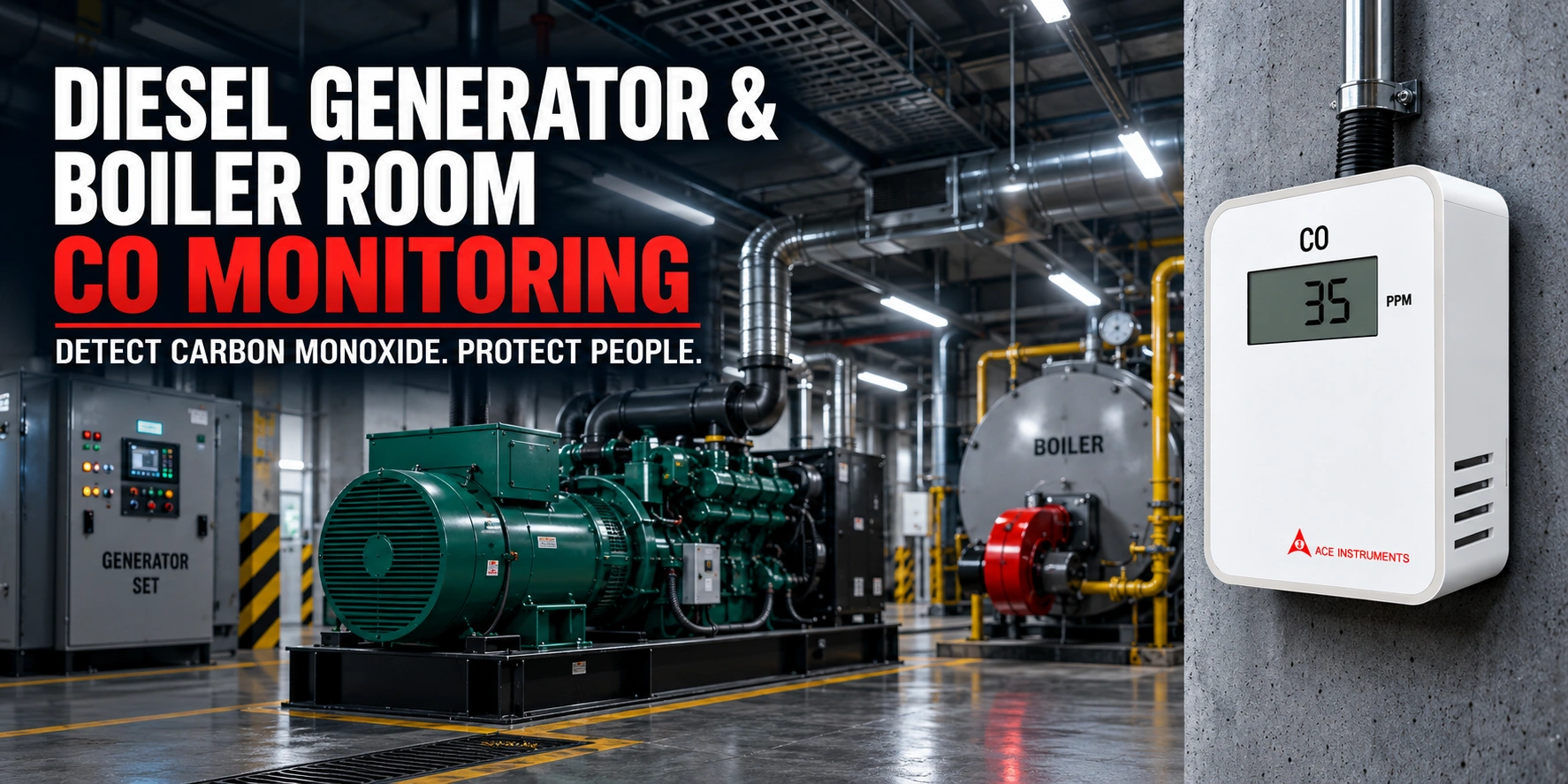
Diesel generator rooms and boiler rooms produce carbon monoxide whenever combustion is incomplete or when exhaust escapes its intended path into the enclosure. Both conditions are ordinary rather than exceptional, and both are silent.
These spaces are also the most commonly under-monitored zones in Indian commercial buildings, where standby generation is near-universal. The reason is structural: plant rooms are unoccupied most of the time, so they attract less attention than spaces where people sit, and the risk materialises precisely when someone enters.
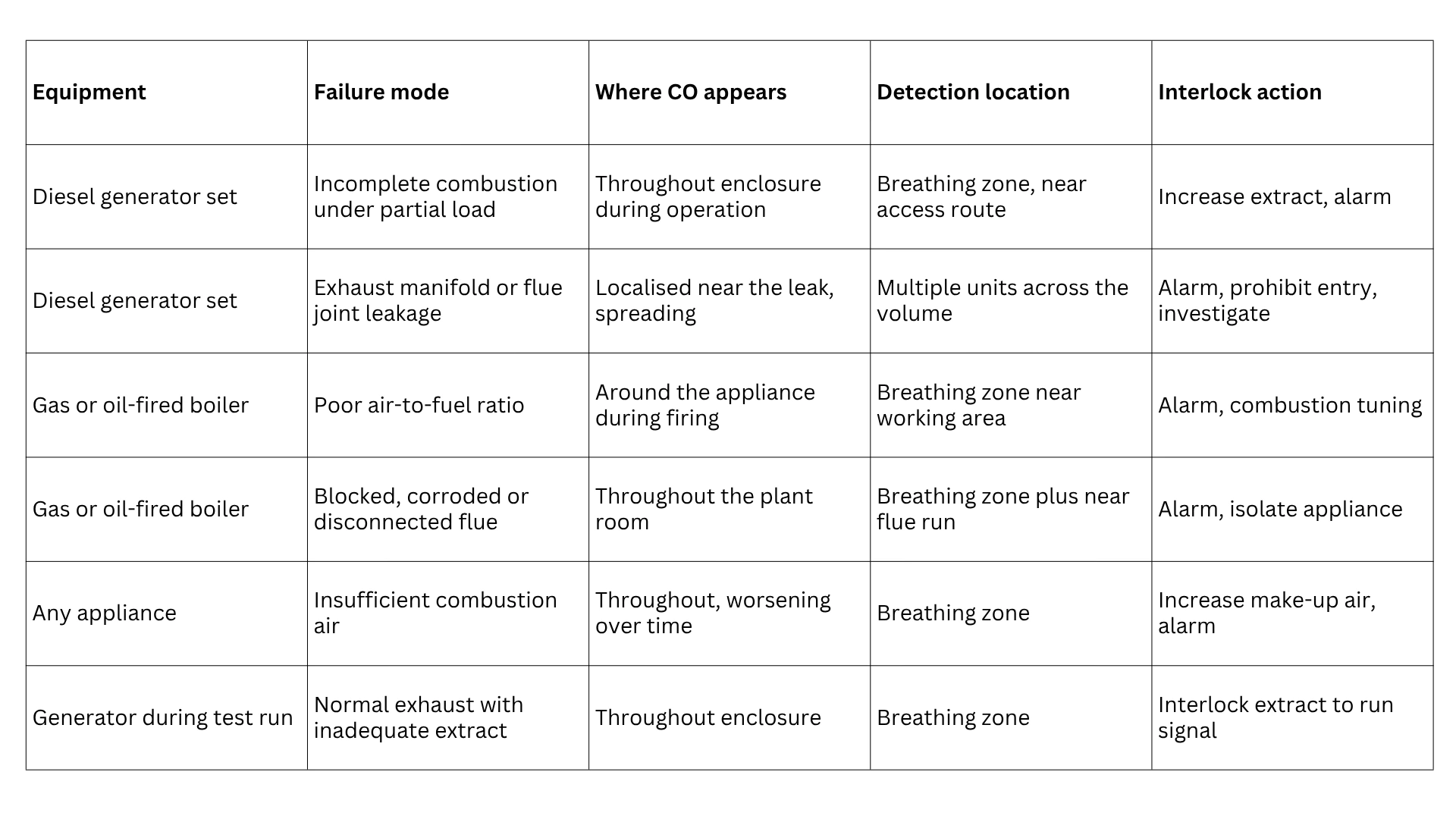
Plant room hazards and detection response
Why plant rooms are a distinct monitoring problem
A car park has continuous low-level emission from many small sources and is occupied constantly by people who are not paying attention. A plant room is the inverse: a small number of very large sources, an enclosure that is usually empty, and occupants who enter deliberately for a defined task.
That inversion changes the design objective. In a car park, monitoring manages an average exposure across a population. In a plant room, monitoring protects a small number of people at the moment of entry, and gives them information they cannot obtain any other way.
It also changes which threshold governs. Car park design is driven by the eight-hour time-weighted average. Plant room design is driven far more by the ceiling value: the NIOSH ceiling of 200 ppm is the more relevant figure when a technician enters an enclosure for twenty minutes. The full set of thresholds is set out in the exposure limit comparison.
The failure mode that matters most: exhaust leakage
Incomplete combustion is the textbook source of carbon monoxide, and it is real. But in a plant room the more consequential failure is exhaust containment.
A generator exhaust system carries the entire combustion output of the engine at high temperature and, in many configurations, at slight positive pressure relative to the enclosure. Manifold gaskets, flexible bellows, silencer joints and flue sections are all subject to thermal cycling across every start and stop. Over years of service, joints loosen and materials fatigue.
When a joint fails, the enclosure receives raw exhaust rather than the trace products of imperfect combustion. Concentrations rise quickly and to levels far above anything a tuning problem would produce.
Three characteristics make this specifically dangerous. Diesel exhaust smell gives no reliable indication of carbon monoxide concentration. It occurs during operation, which for a standby set may be a monthly test run with a technician present. And it worsens gradually, so the condition that eventually becomes dangerous existed unnoticed at a lower level for a long time.
Fixed monitoring addresses all three: it does not require anyone to be present, it detects the trend rather than only the crisis, and it gives a number rather than an impression.
Ventilation interlocks
Plant room ventilation is usually sized for heat rejection rather than contaminant dilution, and often runs on a thermostat or on the equipment run signal. Carbon monoxide monitoring adds a second, independent input
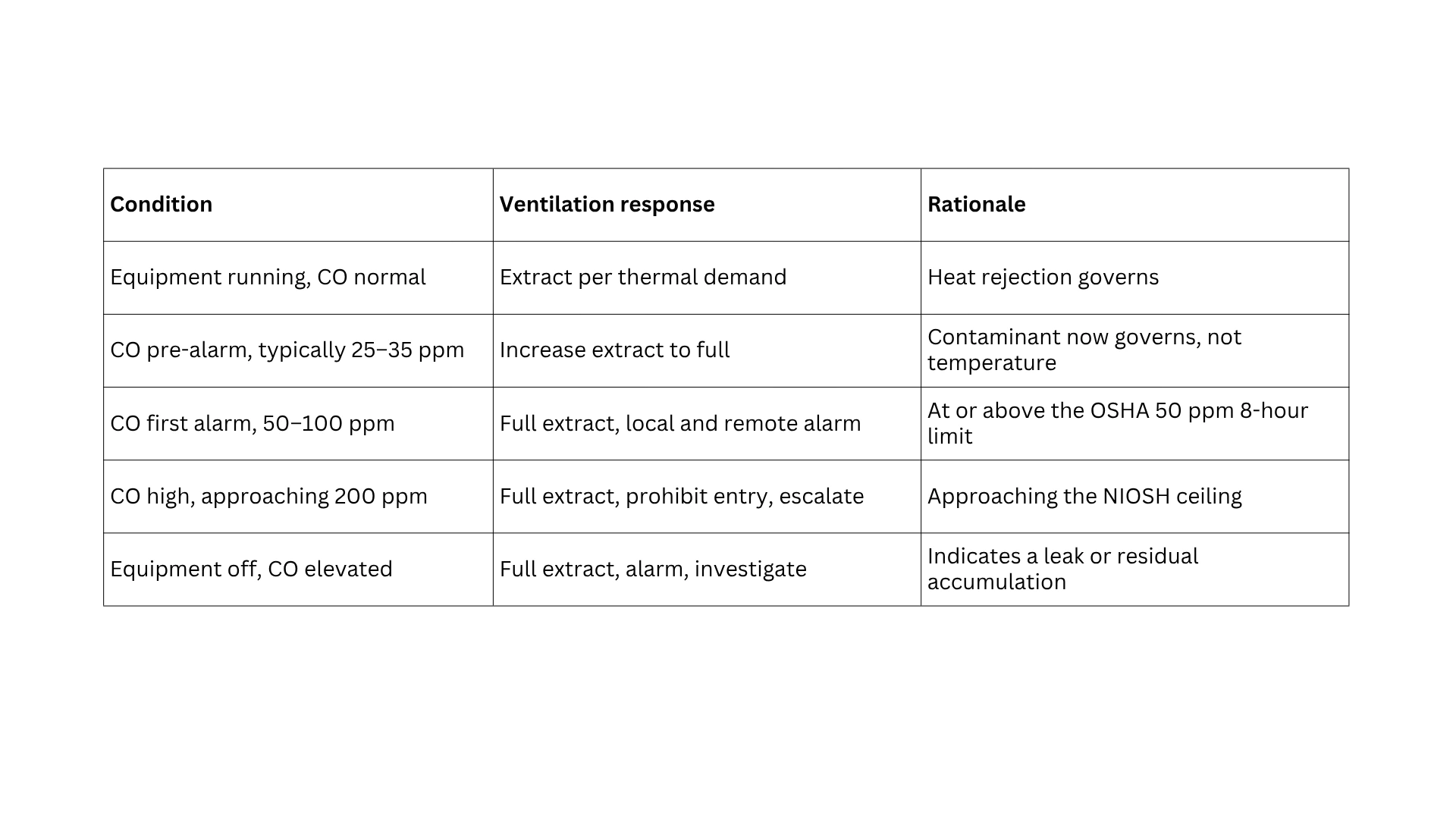
The final row is diagnostically valuable. Elevated carbon monoxide with the equipment shut down means the source is not normal operation. It points to a flue path leaking under natural drought, to migration from an adjacent space, or to an appliance that has not fully shut down.
Automatic shutdown of the equipment on high carbon monoxide is sometimes specified, and it needs care. Shutting down a standby generator during an outage has consequences of its own, and the interlock should be agreed with the generator supplier and the site safety case rather than applied as a default.
Adjacent hazards in the same enclosure
Plant rooms rarely present a single hazard, and a monitoring specification that addresses only carbon monoxide may leave the more immediate risk uncovered.
Enclosed plant rooms with combustion equipment can experience oxygen depletion, and where inert gas systems or large fuel volumes are present the risk is more direct. The oxygen deficiency range addresses this parameter, with the OSHA deficiency threshold of 19.5% under 29 CFR 1910.146 as the reference point.
Where battery banks for generator starting or UPS systems share the enclosure, hydrogen is liberated during charging. This is both a flammability hazard in its own right, addressed by LEL detection, and a cross-interferent for electrochemical carbon monoxide cells, which respond to hydrogen by a similar oxidation pathway. The interaction is explained in how electrochemical detection works, and it is a specification issue rather than a nuisance to be tolerated.
Instrument selection and placement
Plant rooms are thermally severe, and sustained high temperature shortens electrochemical cell life. Instruments should sit in the occupied working volume rather than adjacent to the heat source, which serves both measurement representativeness and instrument longevity. Mounting height follows the same logic as elsewhere: breathing zone, around 1.5 metres above floor level, positioned along the normal access route so that a rising concentration is detected before anyone reaches the far end of the enclosure. The full reasoning is set out in the placement and coverage guidance.
The AI-CO Carbon Monoxide Transmitter from Ace Instruments is the standard field device for plant room monitoring under the IAQ Detectors brand, with output options for connection to ventilation control panels or a building management system covered in the guidance on BMS integration. The sources that make plant room monitoring necessary are covered in what causes carbon monoxide build-up in commercial buildings.
Ace Instruments has designed and manufactured indoor air quality instrumentation in Hyderabad since 1991, with more than 1,000 installations worldwide. The IAQ Detectors range is CE certified and manufactured under an ISO 9001:2015 registered quality system. The full range is available in the carbon monoxide category.
Frequently asked questions
Do diesel generator rooms need carbon monoxide detectors?
Diesel generator rooms warrant fixed carbon monoxide monitoring because they combine a high-output combustion source with an enclosed volume and infrequent human presence. The characteristic hazard is exhaust manifold or flue leakage inside the enclosure, which produces no visible or audible warning and can raise concentrations to dangerous levels before anyone enters. Monitoring protects maintenance access and can interlock ventilation and shutdown.
Where should a carbon monoxide detector be placed in a boiler room?
Place carbon monoxide detectors in a boiler room at breathing zone height, around 1.5 metres above floor level, in the area where maintenance staff work and along the normal access route rather than directly above the appliance. Carbon monoxide has a relative density of 0.967 and mixes rather than rising, so ceiling mounting delays detection. Additional units near flue joints and draught diverters help localise a leak.
What carbon monoxide level should shut down a generator room?
Automatic shutdown thresholds are project-specific and should be set in consultation with the generator supplier and the safety case, because shutting down standby power has its own consequences. Common practice escalates ventilation first, alarms at concentrations approaching the 50 ppm OSHA eight-hour limit, and reserves shutdown or entry prohibition for concentrations approaching the NIOSH ceiling of 200 ppm.
Can a flue leak be detected by a carbon monoxide transmitter?
Yes. A flue or exhaust manifold leak releases combustion products directly into the plant room, and a fixed carbon monoxide transmitter positioned in the occupied volume will detect the resulting rise. It will not identify the leak location, so multiple units are used in larger plant rooms to indicate which area is affected. Detection depends on the instrument holding calibration, which requires a documented service schedule.
Know the latest trends in IAQ solutions from the Ace Instruments team


Get inspired and learn more
Instruments that exceed your technical expectations
Comprehensive and customized IAQ solutions for all applications

