
Model: AI-CO
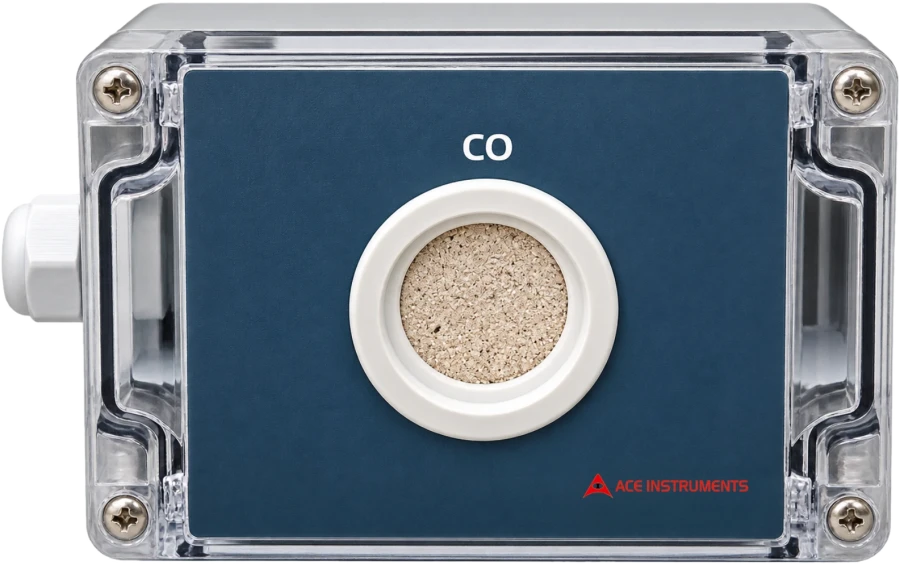
Carbon Monoxide Transmitter, Wall Mount (AI-CO)
Carbon monoxide has no color, no smell, and no warning. A wall mounted transmitter that watches the air in parking garages, boiler rooms, and plant areas, and tells your ventilation or building system when the level rises.
- Sensor
- Electrochemical, UL2034, EN50291, EN54-31
- Range
- 0 to 100, 250 or 500 ppm
- Accuracy
- ±5 ppm or ±5% of reading
- Outputs
- 4 to 20 mA or 0 to 10 VDC, optional RS-485 Modbus
Product overview
The AI-CO is a wall mounted carbon monoxide transmitter. An electrochemical sensor that meets UL2034, EN50291, and EN54-31 requirements measures CO in the surrounding air, and the transmitter sends the reading as an analog signal that your BMS, PLC, or ventilation controller can act on. It has no display of its own, so it sits quietly on the wall and works in the background.
For a building, that means people in garages, plant rooms, and service areas are covered by continuous monitoring, and exhaust fans can run when the air needs them instead of all day. An optional relay and an optional RS-485 Modbus link let it switch a fan or report to a central system, and an optional buzzer gives a local alert.
How it works
The electrochemical sensor reacts to carbon monoxide in the air, and the transmitter turns that reaction into a standard output, either 4 to 20 mA or 0 to 10 VDC, which you select in the field. The sensor reaches 90% of its final reading within 60 seconds (T90). Four tactile keys on the unit are used for settings. The optional relay can start a fan or other equipment when the CO level crosses the point you program, the optional buzzer sounds a local alert, and the optional RS-485 Modbus link carries the reading to a monitoring system.
Protecting occupants and trimming fan energy
Carbon monoxide cannot be sensed by people, so the only dependable way to know it is rising is an instrument. A transmitter on the wall gives your building continuous awareness of the air in spaces that are easy to forget until something goes wrong.
It also helps the building run efficiently. In a garage, for example, exhaust fans that respond to a CO signal run only when they are needed, instead of all day, so energy is spent where it protects people.
Features
Electrochemical CO sensing
A UL recognized sensor that meets UL2034, EN50291, and EN54-31 requirements.
Three ranges
0 to 100 ppm, 0 to 250 ppm, or 0 to 500 ppm, chosen when you order.
Field selectable output
4 to 20 mA or 0 to 10 VDC, set on site.
Optional relay
One programmable relay with NO, CO, and NC contacts, rated 2 A.
Optional buzzer alarm
A programmable built in buzzer for a local audible alert.
Optional RS-485 Modbus
A digital connection to BMS, PLC, and monitoring systems.
Stable over time
Less than 5% signal loss per year.
Quick response
T90 within 60 seconds.
Wide reach
A typical coverage area of 700 m² (7500 ft²), or a 15 m (50 ft) radius.
Compact wall enclosure
ABS plastic, 104 x 85 x 48 mm.
Simple wiring
Screw terminals for 24 VDC power and the output signal.
Applications
Parking lots and garages
Watches the air where vehicle exhaust builds up, and gives the exhaust fans a signal so they run when CO rises rather than continuously, which saves fan energy.
Boiler rooms
Keeps watch over spaces where combustion equipment can release CO, protecting the staff who work there and the occupants above.
Mines
Provides CO monitoring in underground working areas where air quality has to be tracked.
Boats and marine applications
Monitors enclosed spaces on vessels where engines and heaters can raise CO.
Oil and gas facilities
Covers plant areas where combustion processes generate CO.
Semiconductor manufacturing environments
Supports CO monitoring in process areas that need controlled air.
Choosing your configuration
Choosing the measuring range
All three versions measure the same gas, and the only difference is the top of the range.
0 to 100 ppm
For spaces where you expect low concentrations and want finer readings across a small span.
0 to 250 ppm
A middle range with more headroom.
0 to 500 ppm
For areas where higher concentrations are possible.
Choose the range that matches the levels you expect, and note that it is set when you order.
Choosing the output
4 to 20 mA
Suits most BMS, PLC, and controller analog inputs, and is the usual choice for longer cable runs.
0 to 10 VDC
Suits controllers that expect a voltage signal.
The output is selected in the field, so the same transmitter can be set up for either type when you install it.
Ways the transmitter can respond
Optional relay
Switches a fan starter or other equipment, so the transmitter can start ventilation on its own. Design the external load and control circuit within the 2 A rating.
Optional buzzer
Gives people near the transmitter an audible alert without depending on a screen elsewhere.
Optional RS-485 Modbus
Reports to a BMS, PLC, or central monitoring system.
Installation and maintenance
Where to mount it
The AI-CO is a wall mounted transmitter, and it is not installed in a duct. Mount it on the wall near the point where the airflow starts in the space you are monitoring. Think about where CO is likely to come from, the layout of the room, and the ventilation arrangement.
When mounted on a wall, the sensing area is reduced to approximately half the size. The sensing radius is negatively impacted when interfering factors impact the coverage area. It is subject to proper placement, adequate ventilation and other environmental factors.
It is paramount to place sensors in a manner that ensures maximum coverage area. Some location factors to keep in mind that may negatively impact the sensing radius while planning include:
- Exhaust Vents: Avoid placing sensors directly under exhaust vents. The airflow can disrupt CO reaching the sensor, potentially delaying detection.
- Dead Zones: Stagnant air pockets can trap CO, preventing it from reaching the sensor. Avoid corners, behind pillars, or other areas with minimal air circulation.
- Non-overlapping, Comprehensive Coverage: Each floor of the parking structure requires complete sensor coverage without any redundant areas.
- Wall v/s Pillar Mounting: Wall mounting reduces the detection radius, opt for pillar mounting wherever possible, to ensure maximum utilization of detection radius.
Maintenance
Gas sensors need periodic checks. Inspect the transmitter and confirm its performance on a schedule that follows your site's gas detection maintenance procedures. Ask our team about calibration and sensor replacement requirements for your application.
Specifications
| Model | AI-CO |
|---|---|
| Sensor | UL recognized electrochemical sensor meeting UL2034, EN50291, and EN54-31 requirements |
| Range |
|
| Accuracy | ±5 ppm or ±5% of reading, whichever is greater |
| Output | 4 to 20 mA or 0 to 10 VDC (user field selectable) |
| Display | None, transmitter type |
| Relay | Optional single relay output (NO/CO/NC), freely programmable, rated 2 A |
| Buzzer alarm | Optional programmable built in buzzer alarm |
| Communication | Optional RS-485 Modbus |
| Stability | Less than 5% signal loss per year |
| Response time | Within 60 seconds (T90) |
| Power supply | 24 VDC, 200 mA |
| Typical coverage area | 700 m² (7500 ft²) or 15 m (50 ft) radius |
| Settings | Four tactile keys (Sw1 to Sw4) |
| Wiring | Screw terminal connectors for 24 VDC, 4 to 20 mA, and 0 to 10 VDC |
| Enclosure | ABS plastic wall mounting enclosure |
| Dimensions | 104 mm (H) x 85 mm (W) x 48 mm (D) |
| Storage conditions | -10 to +60 °C |
Need wiring details or a dimensional drawing? Ask our engineers or write to sales@iaqdetectors.com.
How to order
The model code is built as AI-CO, then Range, then Relay, then Communication. For example, AI-CO-250-100-MOD is a 0 to 250 ppm transmitter with one relay and RS-485 Modbus.
| Range |
|
|---|---|
| Relay |
|
| Communication |
|
Compliance
- SensorThe sensor inside the AI-CO is a UL recognized electrochemical sensor meeting UL2034, EN50291, and EN54-31 requirements.
- Complete transmitterThat describes the sensor, and it is not a certification of the complete transmitter unless separately documented.
- Your safety arrangementsThe transmitter provides the measurement, alarm outputs, and signals for BMS integration, and it assists your safety arrangements. You set the alarm points from your own risk assessment and local requirements.
- Quality systemAce Instruments manufactures under an ISO 9001:2015 certified quality management system.
Frequently asked questions
What is the AI-CO Wall Mount Carbon Monoxide Transmitter?
The AI-CO is a wall mounted carbon monoxide transmitter designed to continuously measure CO concentration in the surrounding air. It uses an electrochemical sensing element and provides an analog output for connection to compatible monitoring and control systems.
Why is carbon monoxide monitoring important?
Carbon monoxide is a harmful gas that cannot be detected by human senses. Continuous monitoring helps identify increasing CO concentrations and allows facility operators to take appropriate action when required.
How does the AI-CO detect carbon monoxide?
The transmitter uses an electrochemical sensor to detect carbon monoxide in the air and convert the measured concentration into an electrical output signal. This signal can be used by a connected controller or monitoring system.
What measurement ranges are available?
The AI-CO is available in three measurement ranges: 0 to 100 ppm, 0 to 250 ppm, and 0 to 500 ppm. The required range must be selected when placing the order, depending on the application.
How accurate is the AI-CO transmitter?
The specified accuracy is ±5 ppm or ±5% of the reading, whichever is greater. This allows users to monitor carbon monoxide levels within the selected measurement range.
What type of sensor is used in the AI-CO?
The transmitter uses a UL recognized electrochemical sensor meeting UL2034, EN50291, and EN54-31 requirements. This sensing technology is used for carbon monoxide detection applications.
Does the AI-CO have a built-in display?
No. The AI-CO is a transmitter type instrument without a local display. It provides an output signal that can be connected to an external controller, PLC, BMS, or other compatible monitoring system.
What output signals does the AI-CO support?
The transmitter supports 4 to 20 mA and 0 to 10 VDC analog outputs. These outputs are field selectable, allowing the instrument to be configured according to the connected monitoring or control system.
Can the AI-CO activate an exhaust fan when CO levels increase?
Yes. An optional single programmable relay output is available. It can be configured to operate compatible external equipment, such as a ventilation or exhaust fan, through a suitable control arrangement.
Does the transmitter have an audible alarm?
An optional programmable built in buzzer alarm is available. It provides an audible alert when the configured alarm condition is reached.
Can the AI-CO communicate with a Building Management System (BMS)?
Yes. RS-485 Modbus communication is available as an optional feature. This allows the transmitter to communicate with compatible BMS, PLC, and central monitoring systems.
How quickly does the AI-CO respond to changes in CO concentration?
The specified response time is within 60 seconds (T90). This indicates the time required for the sensor output to reach 90% of its final reading following a change in gas concentration under specified test conditions.
Where should the AI-CO transmitter be installed?
The AI-CO is a wall mounted transmitter and is not installed in a duct. It should be mounted on the wall near the point where the airflow starts in the monitored space. The location should also take account of the application, expected CO sources, and the manufacturer's installation recommendations.
Which applications are suitable for the AI-CO?
The transmitter is suitable for carbon monoxide monitoring in:
- Parking lots and parking garages
- Boiler rooms
- Mines
- Boats and marine applications
- Oil and gas facilities
- Semiconductor manufacturing environments
What power supply does the AI-CO require?
The transmitter operates on a 24 VDC power supply with a specified current requirement of 200 mA. Ensure that the power supply is suitable for the instrument and the installation arrangement.
What type of enclosure is provided?
The AI-CO comes in an ABS plastic wall mounting enclosure. Its dimensions are 104 mm (H) x 85 mm (W) x 48 mm (D), allowing it to be installed in a compact wall mounted arrangement.
What wiring connections are available?
The transmitter uses screw terminal connections for 24 VDC power and the 4 to 20 mA or 0 to 10 VDC output. Wiring should be completed according to the product connection details and the requirements of the connected control system.
How large an area can one AI-CO cover?
The datasheet gives a typical coverage area of 700 m² (7500 ft²), or a radius of 15 m (50 ft). The actual coverage depends on airflow, room layout, and the sources of carbon monoxide, so confirm the number of transmitters needed for your space.
How stable is the AI-CO over time?
The datasheet specifies a signal loss of less than 5% per year. Periodic checks should still follow your site's gas detection maintenance procedures.
How do I read the AI-CO model code when ordering?
The code is built as AI-CO, then range (100, 250, or 500), then relay (000 for none, 100 for one relay), then communication (ANA for analog, MOD for analog with RS-485 Modbus). For example, AI-CO-250-100-MOD is a 0 to 250 ppm transmitter with one relay and RS-485 Modbus.
Is the AI-CO a suitable alternative to Greystone CMD5B1, Q5C, Honeywell GSTC, Resideo 5800CO, or Siemens CO monitors?
Yes, the AI-CO Carbon Monoxide Transmitter is designed as a dependable alternative for commercial and industrial CO monitoring applications commonly handled by products such as:
- Greystone CMD5B1 Series (CMD5B1000, CMD5B1000-010, CMD5B1100, CMD5B1000-MOD)
- Greystone Q5C Series (Q5C-CO-250P-O-X, Q5C-CO-500P-O-X)
- Greystone GDT Series (GDTCOXSMCIR1XXX, GDTCOXSMCVXXXXX, GDTCOXSMCMXXXXX, GDTCOXSMVBR1AXX)
- Honeywell GSTC Series (GSTC-C, GSTC-N)
- Resideo 5800CO (5800CO, 5800COV, 5800COA)
The AI-CO offers:
- Accurate carbon monoxide sensing
- Stable long-term performance
- Easy wall-mount installation
- Analog and Modbus output options for BMS and HVAC systems
- Reliable indoor air quality monitoring for commercial and industrial environments
It can be considered for projects where users are evaluating alternatives to comparable CO monitoring systems from these brands. Greystone, Honeywell, Resideo, Siemens and other mentioned brands are trademarks of their respective owners. Ace Instruments is not affiliated with or endorsed by any of the aforementioned companies.
How can I request a quotation or technical assistance for the AI-CO?
For product specifications, range selection, output configuration, optional relay or buzzer requirements, and pricing, contact the IAQDetectors team through the IAQDetectors website.
Email: sales@iaqdetectors.com
Instruments that exceed your technical expectation
Comprehensive and customized IAQ solutions for every application.
