Air Changes per Hour (ACH)
Monitoring Instruments

IAQ Detectors, the instrumentation brand of Ace Instruments, manufactures CE certified instruments that measure and display the live air change rate of a room. They let facility teams in hospitals, cleanrooms, laboratories and commercial buildings confirm that the ventilation system delivers the air changes it was designed for, every hour of operation.

Required rates vary widely by space: ASHRAE 170-2021 sets 20 total ACH for operating rooms and 12 for isolation rooms, while the US EPA Clean Air in Buildings Challenge recommends more than 5 ACH of clean air in occupied offices and classrooms.

0–500 ACH programmableModbus RS-4854–20 mA optionalHigh / low alarmsCE certified2 instruments

Air change rate reference (ACH)

ACH = airflow (m³/h) ÷ room volume (m³)
051220+
Patient room (ASHRAE 170)4 ACH
Offices, classrooms (US EPA)>5 ACH
Isolation room (ASHRAE 170)12 ACH
Operating room (ASHRAE 170)20 ACH

What is air change per hour (ACH)?

Air change per hour (ACH) is the number of times the full volume of air in a room is replaced by ventilation air in one hour. It is calculated as the hourly airflow supplied to or exhausted from the room divided by the room volume. A room with 12 ACH receives an airflow equal to twelve room volumes every hour.

ACH = Q (m³/h) ÷ V (m³) · Imperial: ACH = cfm × 60 ÷ ft³

How an ACH monitor works

ACH is a calculated value, not a direct reading. The AI-CRS1-TFT pairs a 3.5" touchscreen display with a separate ACH transmitter that measures air velocity in the supply or exhaust duct. Velocity multiplied by the configured duct cross-section gives airflow, and airflow divided by the configured room volume gives live ACH.

Because duct size and room volume are entered at commissioning, accuracy depends on those figures matching the installation. Ace Instruments engineers review them during configuration.

Why design ACH and measured ACH drift apart

A commissioning test confirms the air change rate only on the day it is measured. Filter loading, fan wear, damper adjustments and rebalancing all reduce airflow afterwards, usually without triggering any other alarm. Continuous monitoring with high and low limits shows the drop when it happens rather than at the next annual validation.

ACH, CO₂ and room pressure: which to monitor

ACH confirms how much air a room receives. CO₂ shows whether that air keeps pace with the people in the room, and differential pressure shows which way air moves between rooms. Critical spaces such as isolation rooms monitor ACH and pressure together; occupied offices and classrooms pair ACH with CO₂.

See also: Pressure instruments · CO₂ instruments

Recommended air changes per hour by space

Standard-cited rates used to set ACH alarm limits

SpaceAir change rateStandard / source
Operating room20 total ACH (4 outdoor); positive pressureASHRAE 170-2021
Airborne infection isolation room12 total ACH; negative pressureASHRAE 170-2021
Protective environment room12 total ACH; positive pressureASHRAE 170-2021
General patient room4 total ACH (2 outdoor)ASHRAE 170-2021
Occupied offices and classroomsMore than 5 ACH of clean airUS EPA Clean Air in Buildings Challenge (2022)
Non-healthcare spaces (tiered)4 good · 5 better · 6 bestLancet COVID-19 Commission (2022)
Pharmaceutical cleanroomsSet by design to achieve the ISO class; no fixed ACH in the standardISO 14644-1:2015 / ISO 14644-4:2022

Always confirm the ACH target against the applicable building code, design standard and project specification before configuring alarm limits.

ACH instruments

Dedicated ACH monitor and multi-parameter room monitor

2 instruments
Dedicated ACH monitorAir Changes per Hour Monitor with Touch Screen by IAQ Detectors, Ace Instruments

AI-CRS1-TFT

Air Changes per Hour Monitor with Touch Screen

ACH
0–500 ACH3.5" TFTRS-485 Modbus4–20 mA opt.
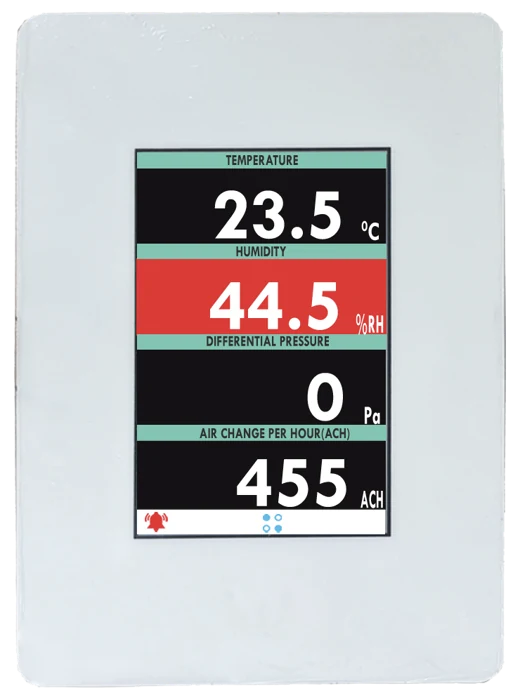
Multi-paramTouchscreen Room Pressure Monitor by IAQ Detectors, Ace Instruments

Touchscreen Room Pressure Monitor

ΔPACHTempRH
TouchscreenRoom statusBMS ready

Instrument comparison

Dedicated ACH monitor versus multi-parameter room monitor

FeatureACH Monitor (AI-CRS1-TFT)Touchscreen Room Pressure Monitor
Air changes per hour✓✓
Differential pressure–✓
Temperature / humidity–✓
ACH range0–500 ACH, programmableConfirm with Ace Instruments
Display3.5" TFT touchscreenTouchscreen
High / low alarmsBuzzer + acknowledge key✓
OutputRS-485 Modbus RTU; 4–20 mA optionalBMS communication
MountingFlush, modular or brick wallWall
Best forVentilation verification in any roomIsolation rooms, theatres, cleanrooms

Common applications

Where the air change rate is part of the design basis

🏥

Hospitals & labs

Verify operating theatres and isolation rooms hold the total ACH set by ASHRAE 170-2021.

🧪

Pharmaceutical cleanrooms

Confirm air change rates that support the room's ISO class between requalifications.

🏫

Schools & classrooms

Track classrooms against the US EPA target of more than 5 ACH of clean air.

🏢

Office buildings

Balance ventilation against HVAC energy instead of over-supplying air to every floor.

Office buildings →
🔋

Data centres & battery rooms

Confirm UPS battery rooms are ventilated as designed to dilute hydrogen.

🅿️

Car parks & hospitality

Check enclosed car parks and kitchens receive their design ventilation rate.

Frequently asked questions

Answers referenced against ASHRAE 170-2021, US EPA and the Lancet COVID-19 Commission

What is air change per hour (ACH)?

Air changes per hour (ACH) is the number of times the volume of air in a room is replaced by ventilation air in one hour. It is calculated by dividing the hourly airflow supplied to or exhausted from the room by the room volume, so 12 ACH means an airflow equal to twelve room volumes every hour.

How do you calculate air changes per hour?

Divide the airflow in cubic metres per hour by the room volume in cubic metres. A 6 m × 5 m room with a 3 m ceiling holds 90 m³; a supply of 1,080 m³/h gives 1,080 ÷ 90 = 12 ACH. In imperial units, ACH = cfm × 60 ÷ room volume in cubic feet.

What is the recommended ACH for hospital rooms?

ASHRAE Standard 170-2021 requires 20 total ACH (4 outdoor) for operating rooms, 12 total ACH for airborne infection isolation and protective environment rooms, and 4 total ACH (2 outdoor) for general patient rooms. Local codes and the project design criteria can set higher values.

What ACH is recommended for offices and classrooms?

The US EPA Clean Air in Buildings Challenge (2022) recommends more than 5 air changes per hour of clean air in occupied spaces, and the Lancet COVID-19 Commission (2022) proposed 4, 5 and 6 ACH as good, better and best targets. ASHRAE 62.1-2022 sets ventilation per person and per floor area rather than as an ACH figure.

How does an ACH monitor measure air changes?

The AI-CRS1-TFT measures air velocity in the supply or exhaust duct, multiplies it by the configured duct cross-section to get airflow, and divides by the configured room volume to display live ACH. The range is programmable from 0 to 500 ACH, with high and low alarms and RS-485 Modbus RTU output to the BMS.

1991
Ace Instruments founded, Hyderabad, India
CE / ISO 9001:2015
CE certified, ISO 9001:2015 quality management
1,000+
Installations worldwide
10,000 sq.ft
Manufacturing & design facility, Hyderabad

Expert guidance

Need help configuring ACH for your room?

Send us the room dimensions, duct size and target air change rate. Ace Instruments application engineers will configure the AI-CRS1-TFT and its alarm limits for your space. Most enquiries answered within 24 hours.

Talk to an expert →sales@iaqdetectors.com

+91 81210 25651 · Hyderabad, India