
Carbon Monoxide Monitoring in Basement Car Parks: Design, Setpoints and Fan Control
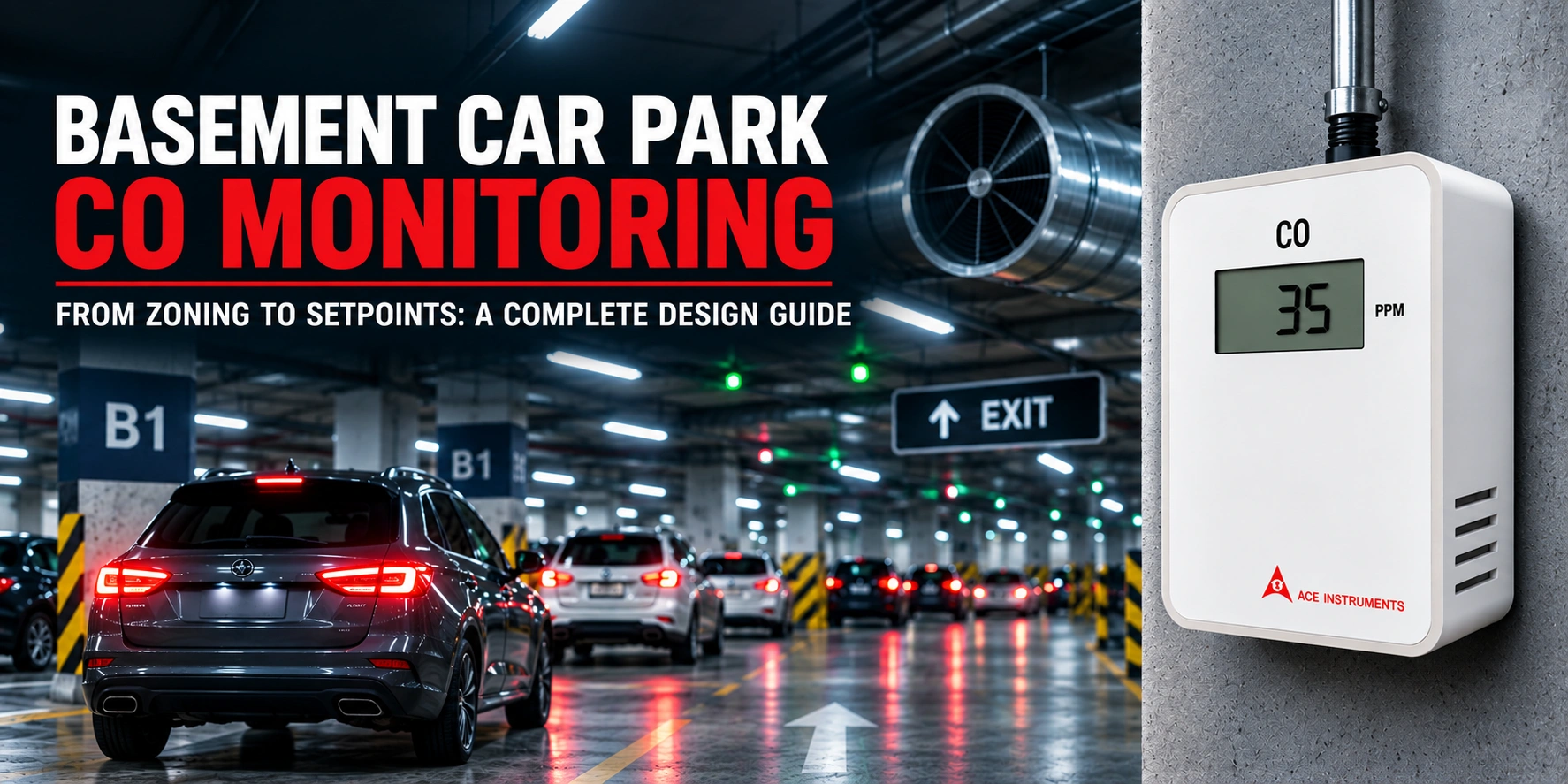
Carbon monoxide monitoring in a basement car park exists to do one job: measure the contaminant that vehicles produce and use it to run the extract system only as hard as conditions require. Done well, it satisfies the ventilation obligation, protects occupants, and cuts fan energy substantially against continuous operation.
Done badly, it produces a system that alarms too late, runs fans that were never needed, or measures a volume other than the one it is controlling. This guide covers the design decisions in sequence, from zoning through setpoints to instrument selection.
Staged setpoints and fan response
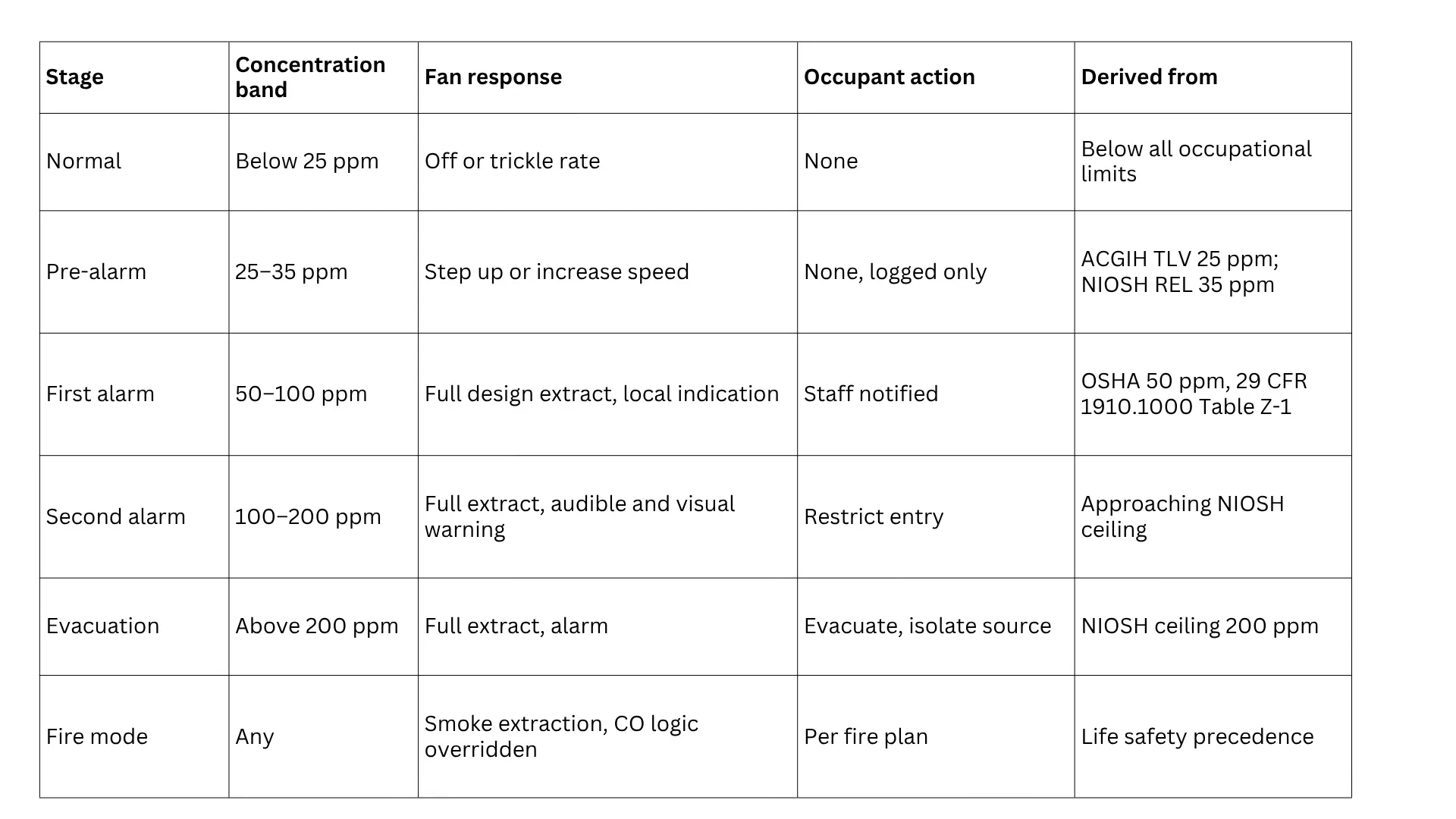
These bands reflect common commissioning practice. They are not prescribed by any single standard. EN 50545-1, the European standard for car park gas detection apparatus, specifies alarm levels for type testing purposes only and states that all alarm levels are variable and may be adapted to national and local regulations. In India, the values that will be approved are governed by the National Building Code 2016 and state fire service conditions.
Step 1: Zone the car park to the ventilation, not the architecture
The most consequential decision in the design is also the earliest. A carbon monoxide reading exists to control a specific fan set, which means the instrument must measure the volume that fan set actually serves.
Zoning to the architectural grid produces a predictable failure: an instrument sited in a bay whose air is drawn away by an adjacent zone’s extract reads low, holds its own fans down, and lets concentration build in the volume it was supposed to protect. The reading is accurate and the control is wrong.
Zone boundaries should follow the airflow. In a ducted extract system that generally means the served area of each extract branch. In a jet fan or impulse system, where there are no ducts and air is pushed toward extract points, zones follow the induced flow paths, which requires the fan layout to be settled before the detector layout can be.
Step 2: Place the instruments where the air is representative
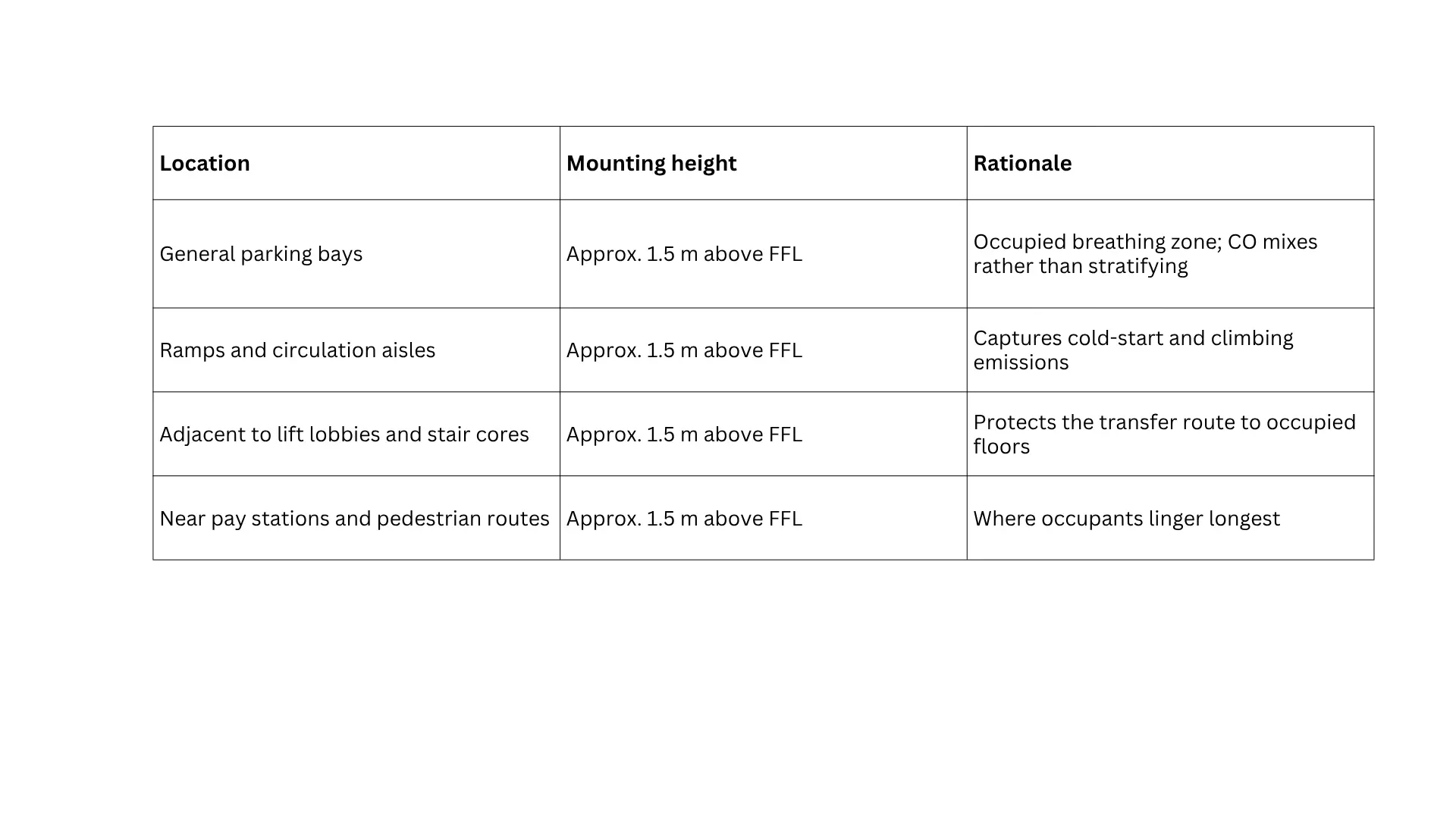
Carbon monoxide has a relative density of 0.967 relative to air. It is close enough to neutral that it mixes through the available volume rather than rising to the soffit or settling at floor level. There is therefore no height at which the gas usefully concentrates, and no benefit to ceiling mounting, which only delays detection while the gas reaches the instrument.
Placement exclusions matter as much as placement. Instruments should be kept clear of extract grilles, where they will read artificially low because they sit in air already being removed; away from fresh air intakes, for the same reason; out of the direct discharge path of jet fans, where high velocity affects reading stability; and out of dead corners that no airflow reaches, where they will read a volume nobody occupies. The full reasoning and coverage figures are set out in the placement and coverage guidance.
Step 3: Set the staging so ventilation leads the limit
The purpose of staging is to keep the time-weighted average comfortably below the enforceable limit, not to alarm when the limit is reached.
That distinction is easy to lose. An eight-hour average of 50 ppm complies with OSHA 29 CFR 1910.1000 Table Z-1; a system whose first response occurs at 50 ppm will spend meaningful time above it. The pre-alarm at 25 to 35 ppm exists to make that impossible, by increasing extract while the average is still low.
The bands also need enough separation to avoid hunting. A pre-alarm at 30 ppm and a first alarm at 35 ppm will cycle fans continuously as concentration fluctuates around the boundary, wearing plants and generating nuisance events. Sensible practice is a clear gap between stages plus a deadband on the falling edge, so fans do not drop back the moment concentration dips.
Public-space considerations pull the setpoints down rather than up. Car park users are members of the public, not a monitored workforce, and include people who would not be represented by occupational limits. Where a design decision is marginal, the more protective figure is the defensible one. The reasoning behind each threshold is set out in the carbon monoxide exposure limit comparison.
Step 4: Define the fire interface unambiguously
Carbon monoxide control and smoke extraction are two duties on the same plant, and their priority must be settled explicitly.
Fire mode overrides carbon monoxide logic without condition. On a fire alarm signal, the system switches to its smoke extraction regime regardless of measured concentration, and carbon monoxide-based control has no ability to reduce or inhibit it. Fire mode is typically a substantially higher extract rate, and the changeover should be tested at commissioning rather than assumed.
Step 5: Select instruments that suit the environment
A basement car park is a demanding location for fixed instrumentation. Ambient temperatures in Indian basements run high through much of the year, humidity is elevated in coastal cities, dust loading is continuous, and the instruments are exposed to vehicle exhaust for their entire service life.
Electrochemical detection is the appropriate technique at these concentrations. Sustained high temperature and very low humidity both shorten cell life, and degradation is gradual rather than sudden, so an aging cell reports plausible but progressively low readings. The mechanism is explained separately.
Selection criteria that matter in this environment:
- Continuous proportional output rather than threshold contacts, so the fan controller can modulate rather than switch
- Stated cell service life and a replaceable cell, since this is a consumable across the building’s life
- Temperature compensation across the range the basement actually experiences
- Tolerance of air velocity, since a car park under extract is not still air
- Output type matched to the control system, whether analogue per point or a digital trunk
Step 6: plan commissioning and ongoing verification
A carbon monoxide system that has never been tested against gas is an assumption, not a control. Commissioning should verify that each instrument responds to applied gas, that the response drives the correct fan zone, that staging occurs at the design setpoints, and that fire mode overrides correctly. Because electrochemical cells drift low as they age, a documented bump testing and calibration schedule then keeps those readings defensible.
Instrumentation and integration
Ace Instruments manufactures fixed carbon monoxide instrumentation under the IAQ Detectors brand specifically for enclosed and basement car parks. The AI-CO Carbon Monoxide Transmitter is the standard field device, using electrochemical detection with a continuous proportional output for direct connection to fan control panels or a building management system. Where measurement within an extract or supply air stream is required, the AI-CO-D Duct Carbon Monoxide Transmitter applies the same technique in duct-mounted form.
Output selection is a design decision in its own right on multi-level basements, where point count and cable run distance determine whether analogue outputs per instrument or a shared RS-485 Modbus RTU trunk is the better topology. That decision is covered in the guidance on BMS integration.
Ace Instruments has designed and manufactured indoor air quality instrumentation from its 10,000 sq ft Hyderabad facility since 1991, with more than 1,000 installations worldwide. The IAQ Detectors carbon monoxide range is CE certified and manufactured under an ISO 9001:2015 registered quality system. The complete range is available in the carbon monoxide category.
Frequently asked questions
At what CO level should car park extract fans start?
Car park extract fans are commonly staged to increase at a first setpoint between 25 ppm and 35 ppm and to reach full design extract between 50 ppm and 100 ppm, so that ventilation responds well before the 50 ppm OSHA eight-hour limit is approached as an average. No standard fixes these values: EN 50545-1 states that alarm levels are variable and may be adapted to national and local regulations, and the approving fire authority has the final say.
How many carbon monoxide detectors does a car park need?
Detector count is determined by ventilation zoning rather than by floor area alone. Each independently controlled fan zone needs at least one instrument measuring the volume that zone serves, with additional units at ramps, near lift lobbies and at any location where vehicles idle. A large open basement under a single jet fan zone may need fewer instruments than a smaller compartmented basement with several fan groups.
What is the standard alarm setpoint for a parking garage CO detector?
There is no single standard setpoint. Typical practice stages a pre-alarm at 25 to 35 ppm, a first alarm at 50 to 100 ppm and an evacuation threshold above 200 ppm, derived from the ACGIH Threshold Limit Value of 25 ppm, the OSHA limit of 50 ppm under 29 CFR 1910.1000 Table Z-1 and the NIOSH ceiling of 200 ppm. Final values are set by the design engineer and the approving authority.
Where should CO detectors be mounted in a basement car park?
Carbon monoxide detectors in car parks are mounted in the occupied breathing zone, typically around 1.5 metres above finished floor level, because carbon monoxide has a relative density of 0.967 relative to air and mixes rather than rising or settling. Ceiling mounting delays detection without any compensating benefit. Detectors should be kept clear of extract grilles, fresh air intakes and jet fan discharge paths.
Know the latest trends in IAQ solutions from the Ace Instruments team


Get inspired and learn more
Instruments that exceed your technical expectations
Comprehensive and customized IAQ solutions for all applications

