
Car Park Ventilation and Carbon Monoxide Monitoring Requirements in India

Enclosed basement car parks in India require mechanical ventilation under the National Building Code of India 2016 and the fire No Objection Certificate conditions issued by state fire departments. Carbon monoxide monitoring is the control input that makes that ventilation operable and energy-viable, which is why it appears in most approved designs even where the code text does not name it separately.
This guide sets out how the Indian regulatory picture actually works for a specifier, where the national code stops and local authority conditions begin, and how carbon monoxide instrumentation fits into an approvable design.
The regulatory framework at a glance
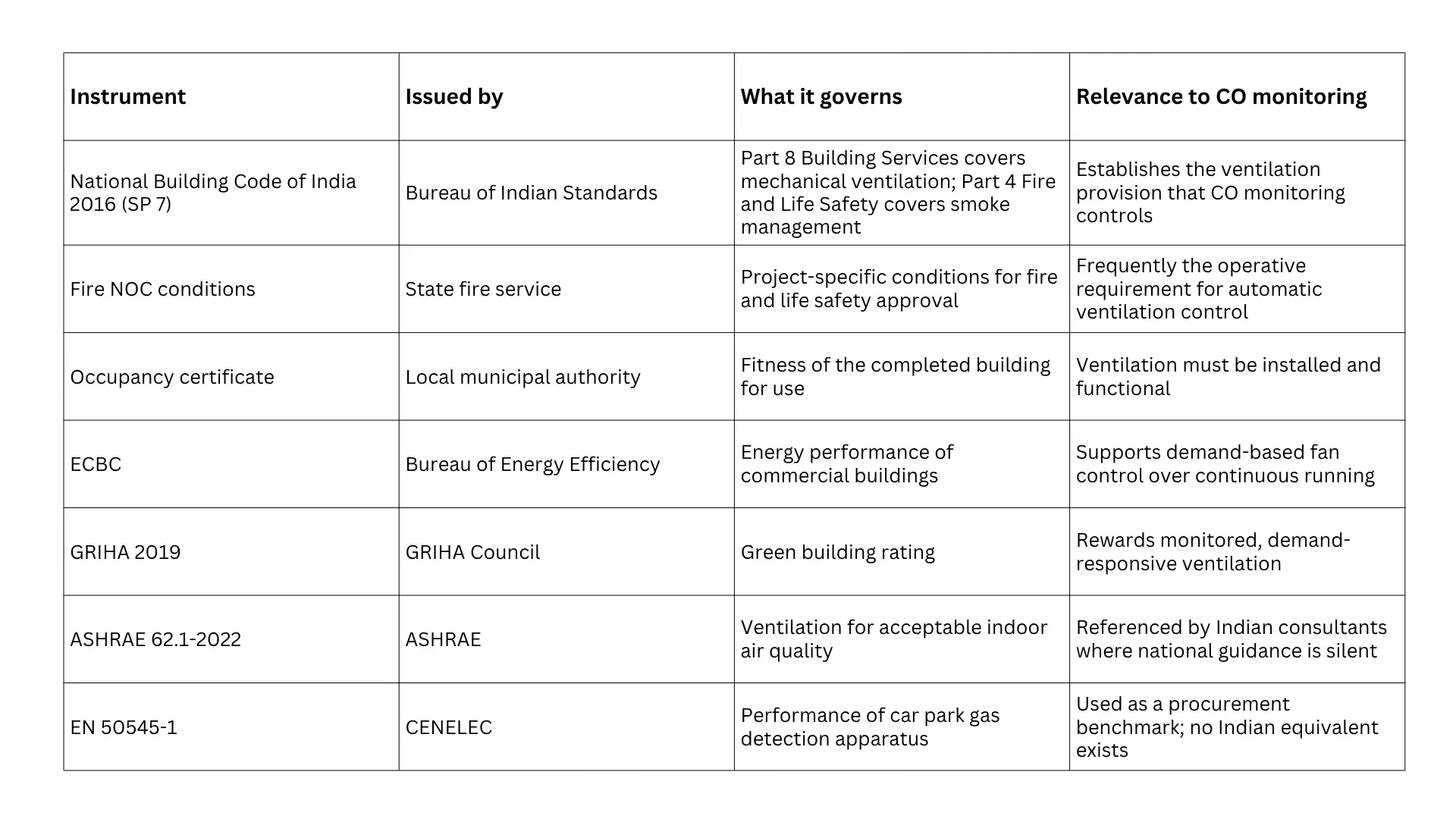
Air change rates: the number everyone asks for
The figure most commonly applied to Indian basement car parks is a minimum of 6 air changes per hour in normal operation, rising to 12 air changes per hour in fire or smoke extraction mode, attributed to the National Building Code 2016. The earlier NBC 2005 was generally applied at higher normal-mode rates, which is why older projects and older specifications often quote 9 to 12 air changes per hour.
Two qualifications matter more than the numbers themselves.
First, the code figure is a floor, not a design target. State fire service conditions routinely impose higher rates. Mumbai projects designed under MMRDA conditions have been built to 15 air changes per hour in normal mode and 30 in fire mode, double the commonly cited national figures. The governing requirement for any given project is always the stricter of the code and the local approval condition, and that condition is not knowable from the code alone.
Second, an air change rate says nothing about when the air changes happen. A car park ventilated continuously at 6 air changes per hour and one ventilated at 6 air changes per hour only when vehicles are present have identical nameplate compliance and very different energy consumption. Carbon monoxide monitoring is what makes the second option possible.
Why carbon monoxide monitoring appears in approved designs
Running basement extract fans continuously at design flow is compliant, simple and extremely expensive. For a multi-level basement in an Indian commercial development, continuous operation of the extract system represents a substantial and permanent load, incurred largely during hours when the car park is nearly empty.
Demand-based control resolves this. Fans idle or run at reduced speed at low occupancy and step up as carbon monoxide concentration rises. The car park meets its ventilation obligation when it needs to and consumes a fraction of the energy when it does not. This aligns directly with the intent of the Bureau of Energy Efficiency ECBC framework and is favourably treated under GRIHA 2019.
The consequence is that carbon monoxide monitoring, though often not named as a standalone mandatory item in the national code text, becomes a de facto requirement of any design that is both approvable and operationally sensible. Fire NOC conditions in many states now explicitly reference automatic ventilation control, and carbon monoxide concentration is the input that drives it.
What an approvable design typically includes
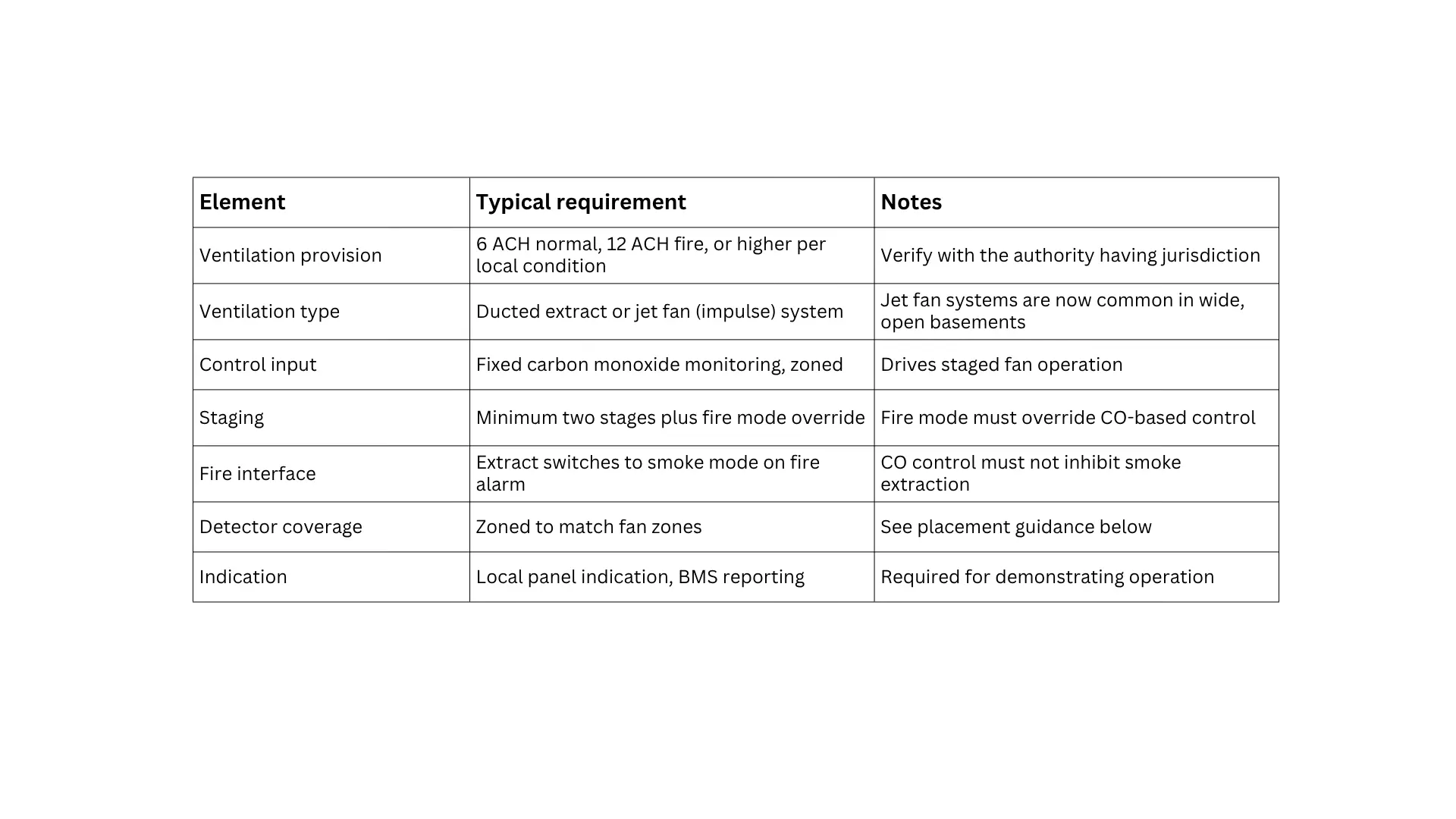
The fire interface deserves emphasis. Carbon monoxide-based control and smoke extraction are two different duties on the same plant, and the fire mode must take precedence unconditionally. A control philosophy in which a low carbon monoxide reading can hold fans down during a fire event will not be approved, and should not be.
Detector zoning and placement
Zoning should follow the ventilation zones rather than the architectural grid, because the purpose of the reading is to control a specific fan set. A zone whose carbon monoxide concentration is measured by an instrument located in the airflow path of a different zone’s extract will produce a control signal that reflects the wrong volume.
Mounting height follows from the physical behaviour of the gas. Carbon monoxide has a relative density of 0.967 relative to air, so it mixes rather than stratifying, and detectors are mounted in the occupied breathing zone rather than at ceiling level. The full reasoning and the coverage figures are set out in the guidance on mounting height and coverage, and the staged setpoint logic in the basement car park design guide.
Instrument selection for Indian conditions
Indian basement car parks impose a demanding environment on fixed instrumentation: high ambient temperature through much of the year, high humidity in coastal cities, dust, and continuous exposure to vehicle exhaust. Electrochemical cell life is affected by all of these, which makes stated service life and replaceability material selection criteria rather than specification detail. The underlying behaviour is explained in how electrochemical detection works.
Because no Indian performance standard for car park gas detection apparatus exists, consultants commonly reference EN 50545-1 as a procurement benchmark. Used properly it is a useful filter; it should be evidenced rather than asserted.
Ace Instruments manufactures fixed carbon monoxide instrumentation under the IAQ Detectors brand from a 10,000 sq ft design and manufacturing facility in Hyderabad, with instruments engineered for Indian operating conditions. The AI-CO Carbon Monoxide Transmitter is the standard field device for basement car park zones, with output options for direct connection to fan control panels or a building management system covered in the guidance on BMS integration. Related ventilation parameters are addressed by the air changes per hour resources.
Ace Instruments has manufactured indoor air quality instrumentation since 1991, with more than 1,000 installations worldwide. The IAQ Detectors range is CE certified and manufactured under an ISO 9001:2015 registered quality system. The full range is available in the carbon monoxide category.
Frequently asked questions
Is carbon monoxide monitoring mandatory in Indian basement car parks?
Mechanical ventilation of enclosed basement car parks is mandatory in India under the National Building Code 2016 and the fire NOC conditions issued by most state fire departments. Carbon monoxide monitoring is not always named as a separate mandatory item in the code text, but it is required in practice because ventilation approvals are commonly conditioned on automatic control, and carbon monoxide concentration is the control input. Confirm requirements with the local fire authority for each project.
What does NBC 2016 say about basement car park ventilation?
The National Building Code of India 2016 addresses mechanical ventilation of enclosed parking in Part 8 Building Services, with fire and smoke management covered in Part 4 Fire and Life Safety. Indian practitioners commonly design to a minimum of 6 air changes per hour in normal operation and 12 air changes per hour in fire mode, though state fire service conditions frequently impose higher rates.
How many air changes per hour are required for basement parking in India?
Six air changes per hour in normal operation is the figure most commonly applied to Indian basement car parks under NBC 2016, rising to 12 air changes per hour in fire or smoke extraction mode. Local authorities may require more. Mumbai projects under MMRDA conditions have been designed to 15 air changes per hour normal and 30 in fire mode, so the governing figure is always the stricter of the code and the local approval condition.
Who approves car park ventilation design in India?
The state fire service issues the fire No Objection Certificate that governs car park ventilation design, and the local municipal authority issues the occupancy certificate. Both can impose conditions beyond the National Building Code. Because approval conditions vary by state and city, ventilation and carbon monoxide monitoring design should be confirmed with the authority having jurisdiction at the design stage rather than assumed from the national code.
Know the latest trends in IAQ solutions from the Ace Instruments team


Get inspired and learn more
Instruments that exceed your technical expectations
Comprehensive and customized IAQ solutions for all applications

