
Why Monitor Carbon Monoxide in HVAC Ducts: Return Air Contamination and Building-Wide Risk
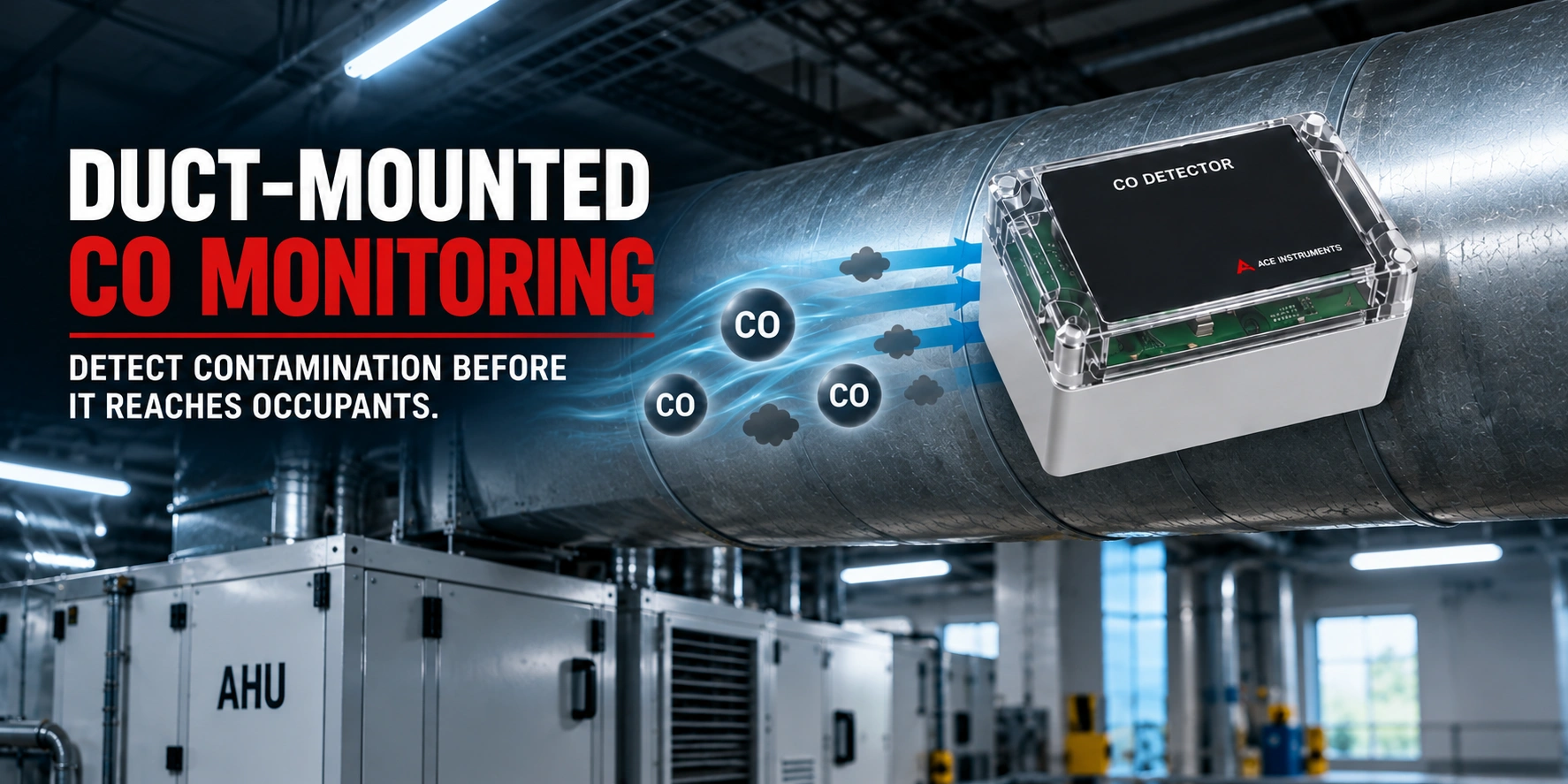
Duct-mounted carbon monoxide monitoring exists because an air handling unit does not know what it is moving. It draws air from an intake or a return path and delivers it to every zone it serves, and if combustion products enter at the intake, the unit distributes them efficiently and building-wide.
Room-level monitoring cannot detect this. A detector in a plant room protects the plant room. Nothing in a conventional zone-monitoring layout is positioned to see contaminated supply air before it arrives.
The contamination pathway
- A combustion source operates near an air intake. A diesel generator exhausts at roof level near a fresh air louvre. A boiler flue terminates within the intake’s influence. A service road or loading bay sits below an intake at low level. None of these is unusual, and all are decisions made by different disciplines at different project stages.
- The air handling unit draws contaminated air. The intake makes no distinction. Under design flow the unit ingests whatever is present in the air at that point.
- Dilution occurs, and hides the problem. Contaminated outdoor air mixes with return air. A high local concentration at the louvre becomes a modest concentration in the supply duct.
- Distribution follows. The diluted concentration is delivered to every zone served by the unit, continuously, for as long as the source operates.
- Nothing alarms. A steady 15 to 25 ppm in supply air is far below the setpoint of any plant room instrument and produces no obvious symptom. It is nonetheless continuous exposure well above the WHO Air Quality Guidelines eight-hour figure of 10 mg/m³, approximately 9 ppm, delivered to occupants who have no reason to suspect it.
Step 3 is the reason the failure mode persists. Dilution does not remove the contaminant; it converts an acute, detectable problem into a chronic, invisible one, and spreads it to more people.
Room-mounted and duct-mounted monitoring compared
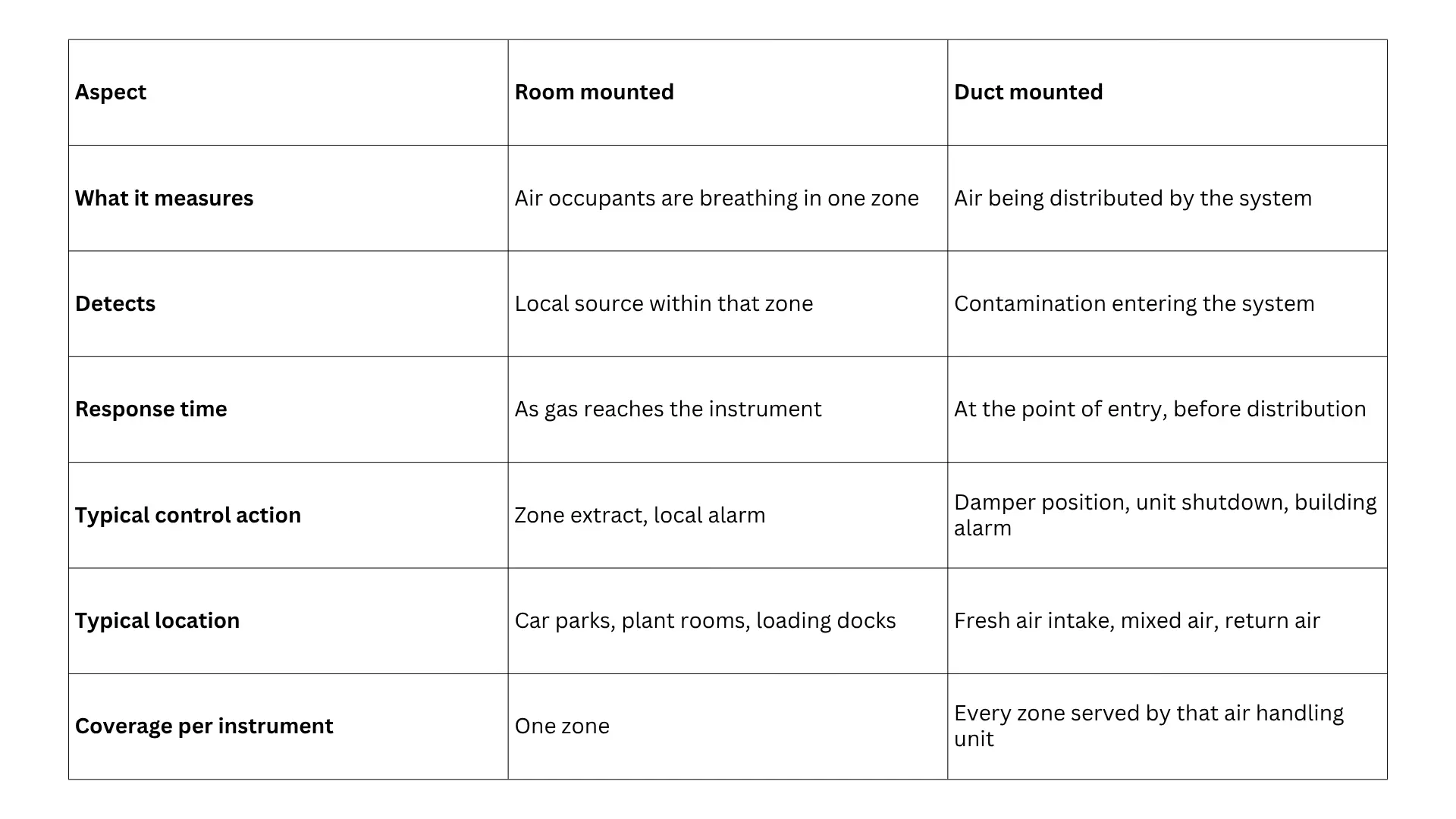
The final row is why duct monitoring is disproportionately valuable relative to its cost. A single instrument in a supply duct provides detection coverage for every zone the unit serves.
Where duct monitoring is warranted
Fresh air intakes with a nearby combustion source. The clearest case. Where a generator exhaust, flue termination, service road or loading bay lies within the influence of an intake, a duct instrument on the fresh air path detects the ingress directly. ASHRAE 62.1-2022 addresses separation between intakes and contaminant sources for exactly this reason; where required separation cannot be achieved on a constrained site, monitoring is the practical mitigation.
Return air paths shared with a car park or plant room. Common in mixed-use developments where basement levels combine parking with plant and the air handling strategy was not fully separated. A duct instrument on the return path detects transfer.
Healthcare and pharmaceutical facilities. Where air handling serves vulnerable occupants or controlled environments, the consequence of distributing a contaminant is disproportionate. ASHRAE 170-2021 governs ventilation of health care facilities, and duct-level detection supports the assurance that supply air is what the design intended.
Getting the mounting position right
A duct instrument reads the air that passes its probe, so the probe must sit in air representative of the whole duct.
Mount in a straight run with fully developed flow, well downstream of any bend, damper, filter bank or junction, since immediately after a disturbance the velocity profile is uneven and the probe may sit in a stream unrepresentative of the duct as a whole. The probe should also reach into the airstream rather than sampling slower-moving boundary-layer air near the duct wall.
Position relative to the mixing point determines what the reading means. Upstream of where fresh and return air combine, the instrument reports the fresh air condition, which identifies an intake problem. Downstream of mixing, it reports what will actually be delivered. Where the distinction matters, both positions are monitored.
Control response
Duct-level detection generally implies a different action from a room alarm, because the problem is systemic rather than local.
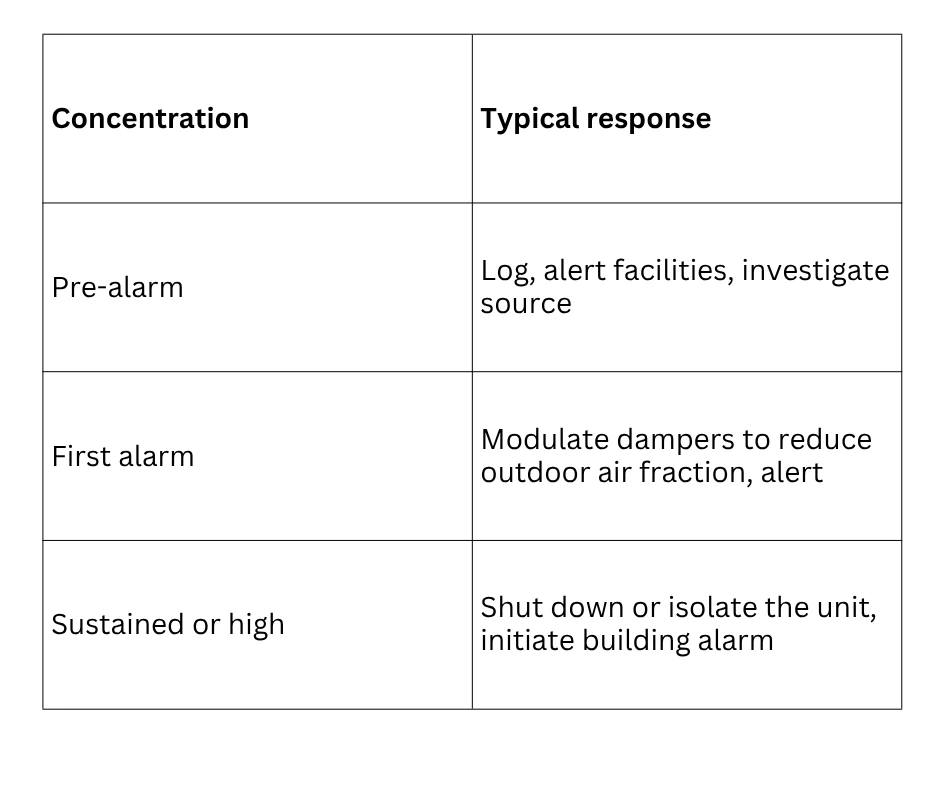
Reducing the outdoor air fraction as a first response is counterintuitive and worth explaining: where the contamination is arriving through the fresh air intake, more outdoor air makes the problem worse rather than better. This inverts the normal ventilation response and is the reason duct carbon monoxide monitoring should be interlocked deliberately rather than wired into a generic air quality logic.
Instrument selection for duct mounting
A duct instrument faces different conditions from a room instrument: continuous airflow across the detection element, a wide velocity range, pressure differential across the duct wall, and often limited access for service.
The AI-CO-D Duct Carbon Monoxide Transmitter from Ace Instruments, supplied under the IAQ Detectors brand, is designed for this duty, applying the same electrochemical detection used in the room-mounted AI-CO in a duct-mounted probe form. The underlying detection behaviour, including how air velocity and temperature affect a cell, is covered in how electrochemical detection works.
Because a duct instrument is typically interlocked with damper control or unit shutdown rather than a simple alarm, output selection matters. Options are covered in the guidance on BMS integration, and the demand controlled context in ASHRAE 62.1-2022 and carbon monoxide. The indoor air quality range covers duct-mounted multi-parameter measurement.
Ace Instruments has designed and manufactured indoor air quality instrumentation from its Hyderabad facility since 1991, with over 1,000 installations worldwide. The IAQ Detectors range is CE certified and manufactured under an ISO 9001:2015 registered quality system. The complete range is available in the carbon monoxide category, and the sources that make duct monitoring necessary are covered in what causes carbon monoxide build-up in commercial buildings.
Frequently asked questions
Should carbon monoxide detectors be installed in HVAC ducts?
Duct-mounted carbon monoxide monitoring is warranted wherever an air handling unit could draw combustion products into the air it distributes. That includes fresh air intakes sited near generator exhausts, flue terminations, service roads or loading bays, and any return air path shared with a car park or plant room. Duct monitoring supplements room-level monitoring rather than replacing it.
Where in the duct should a carbon monoxide transmitter be mounted?
A duct carbon monoxide transmitter should be mounted in a straight run with fully developed, well-mixed flow, generally several duct diameters downstream of any bend, damper or junction. The probe should reach into the airstream rather than sampling near the duct wall, where boundary-layer effects give unrepresentative readings. Position it upstream of the point where contaminated air would be distributed.
Can an air handling unit spread carbon monoxide through a building?
Yes. An air handling unit distributes whatever enters its intake or return path to every zone it serves. Carbon monoxide drawn in from a nearby generator exhaust, flue discharge or loading bay is delivered building-wide at a diluted but continuous concentration. Because the resulting levels are usually modest, the problem often persists undetected by room-level alarms configured for plant room concentrations.
What is the difference between duct and room mounted carbon monoxide monitoring?
Room mounted monitoring measures the air occupants are breathing in a specific zone and is used for local protection and zone ventilation control. Duct mounted monitoring measures the air being distributed and detects contamination at its point of entry into the system, before it reaches any zone. The two answer different questions and are typically specified together on buildings with a combustion risk.
Know the latest trends in IAQ solutions from the Ace Instruments team


Get inspired and learn more
Instruments that exceed your technical expectations
Comprehensive and customized IAQ solutions for all applications

