
Carbon Monoxide vs Carbon Dioxide: What HVAC Engineers Need to Monitor and Why
.webp)
Carbon monoxide is a toxic combustion gas controlled at single and double-digit ppm concentrations, while carbon dioxide is a metabolic and combustion by-product used as an indicator of ventilation adequacy at concentrations around a thousand times higher. They share a name root and nothing operationally useful beyond it.
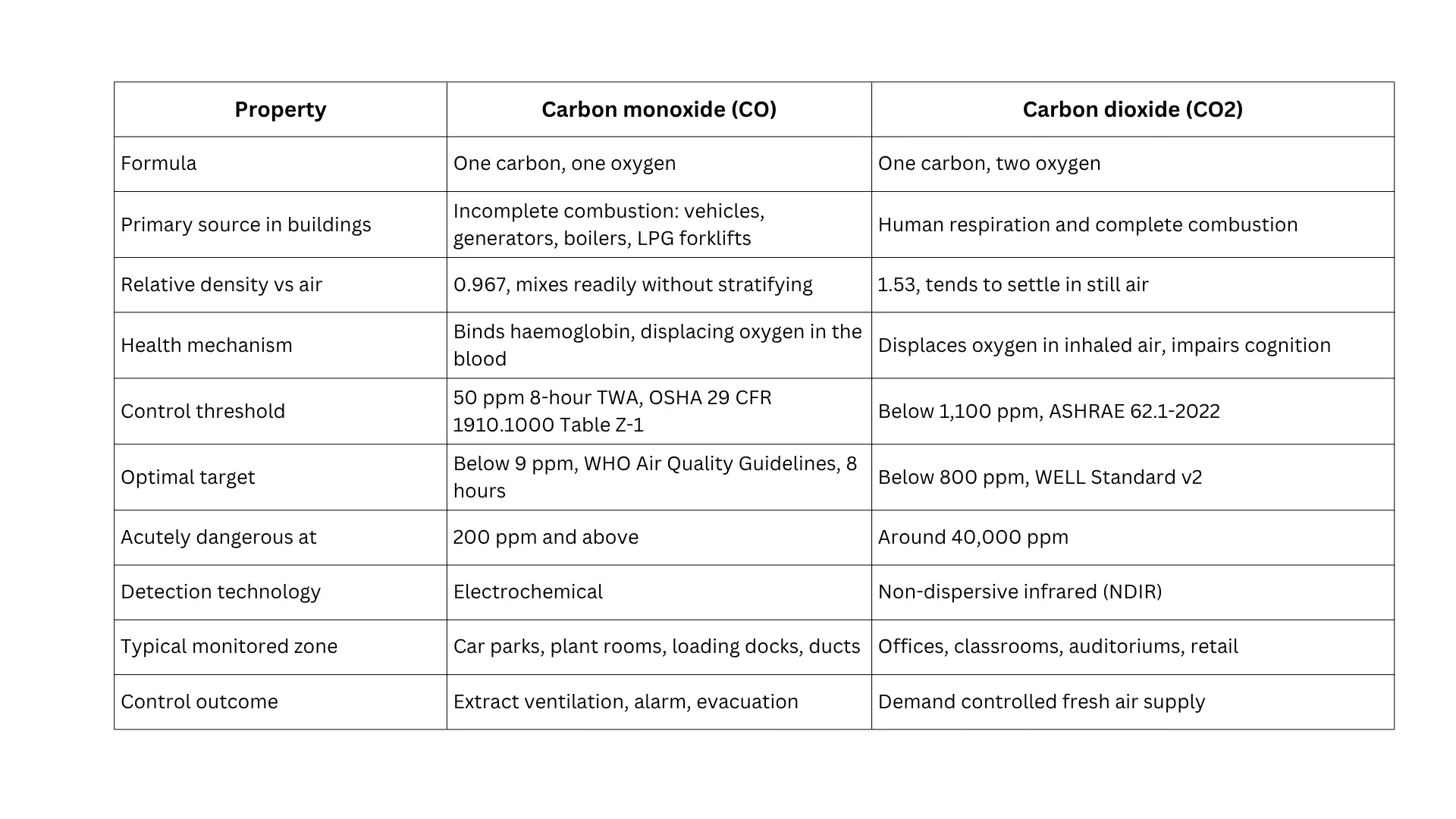
The confusion is common enough that it regularly appears in tender documents, where a specification for carbon dioxide monitoring is issued for a car park, or a carbon monoxide instrument is requested for an open-plan office. The table below settles the distinction in the terms an HVAC engineer needs.
Carbon monoxide and carbon dioxide compared
The difference that matters: one is a hazard, the other is a proxy
Carbon dioxide is not, at building concentrations, the thing anyone is actually worried about. It is measured because it correlates reliably with how much outdoor air each occupant is receiving. A reading of 1,500 ppm in a meeting room does not indicate a poisoning risk; it indicates that fresh air supply has fallen behind occupancy, and that whatever else people are exhaling has accumulated too. Carbon dioxide is a proxy for ventilation rate.
Carbon monoxide is the opposite. It is measured because it is itself the hazard. There is no useful sense in which 60 ppm of carbon monoxide is an indicator of something else. It is a direct measure of a toxic exposure that is accumulating in the bloodstream of everyone in the zone.
This distinction determines the entire control philosophy. Carbon dioxide monitoring modulates ventilation continuously to balance air quality against fan energy. Carbon monoxide monitoring operates in stages, escalating from increased extract to alarm to evacuation, because the failure mode is not discomfort but harm.
Why one instrument cannot do both
The two gases are detected by fundamentally different physics, and no single detection element measures both.
Carbon dioxide instruments use non-dispersive infrared measurement. Carbon dioxide absorbs infrared radiation strongly at a characteristic wavelength, and the instrument infers concentration from how much radiation reaches a detector across a known path. It is a stable, long-lived technique well suited to the thousand-ppm concentrations involved.
Carbon monoxide is measured electrochemically, because infrared absorption is impractical at the single-ppm resolution required. An electrochemical cell oxidises carbon monoxide at a working electrode and produces a current proportional to concentration. The mechanism, its drift behaviour and its cell life are covered separately.
The practical consequence is that specifying a carbon dioxide instrument for a zone with a combustion risk leaves that zone entirely unmonitored for the gas that can actually kill occupants. This is not a marginal shortfall. It is the difference between a system that works and one that does not.
Where each belongs in a commercial building
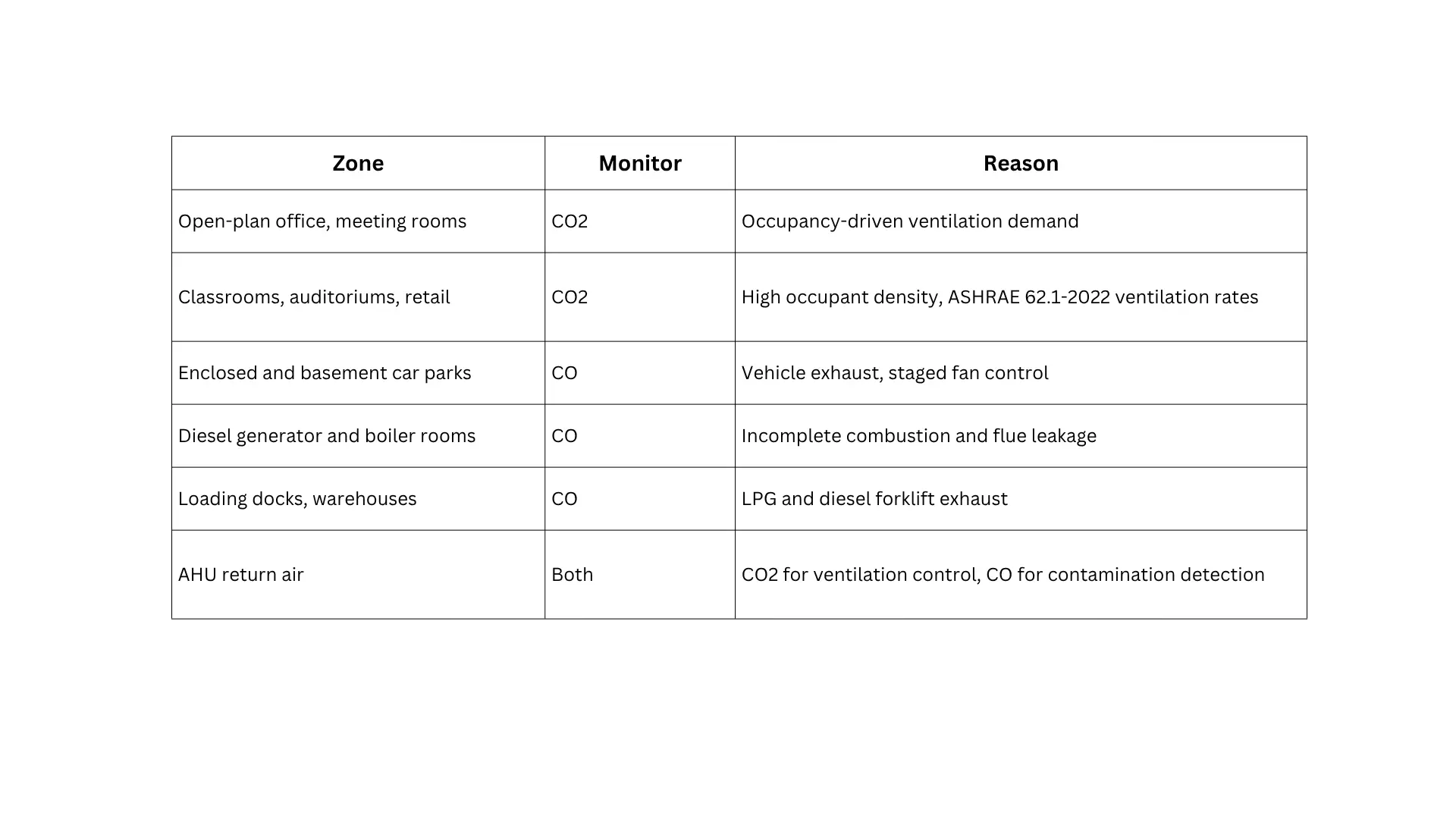
The final row is the one most often missed. A duct-mounted instrument in the return air stream serves two distinct purposes: carbon dioxide measurement gives a building-averaged ventilation signal, while carbon monoxide measurement in the duct detects combustion products entering the air handling unit before they are distributed to every zone it serves.
Specifying both correctly
Where a building requires both parameters, the specification should treat them as independent systems that happen to share a control network rather than as variants of one another. Ranges, alarm logic, placement rules and calibration intervals all differ.
Ace Instruments manufactures both under the IAQ Detectors brand from a single Hyderabad facility, which simplifies integration where a project needs both. The AI-CO Carbon Monoxide Transmitter and duct-mounted AI-CO-D cover the combustion zones, while the AI-CO2 Carbon Dioxide Transmitter and the wider carbon dioxide range address occupancy-driven ventilation. Both families share common output options, so a single BMS can take both signals over the same RS-485 trunk.
Where a project needs several parameters in one enclosure, the indoor air quality range combines carbon dioxide with temperature, humidity, particulate matter and volatile organic compounds. Note that carbon monoxide is deliberately not bundled into general indoor air quality monitors: it belongs where combustion happens, not where people sit, and the two zones rarely coincide.
Ace Instruments has designed and manufactured indoor air quality instrumentation in Hyderabad since 1991. Every instrument in the IAQ Detectors range is CE certified and produced under an ISO 9001:2015 registered quality system, with more than 1,000 installations worldwide. Threshold values for both gases are set out in the carbon monoxide exposure reference.
Frequently asked questions
Is carbon dioxide the same as carbon monoxide?
No. Carbon dioxide (CO2) contains two oxygen atoms and is a normal product of complete combustion and human respiration, controlled below 1,100 ppm under ASHRAE 62.1-2022 as a ventilation indicator. Carbon monoxide (CO) contains one oxygen atom, is produced only by incomplete combustion, and is acutely toxic at concentrations more than twenty times lower, with an OSHA limit of 50 ppm.
Will a CO2 monitor detect carbon monoxide?
No. A carbon dioxide monitor cannot detect carbon monoxide. CO2 instruments use non-dispersive infrared measurement tuned to the absorption band of carbon dioxide, and carbon monoxide absorbs at a different wavelength. Detecting carbon monoxide requires a separate instrument, almost always electrochemical. The two gases require two devices, and substituting one for the other leaves a building unprotected against combustion products.
Which is more dangerous, CO or CO2?
Carbon monoxide is far more dangerous at the concentrations found in buildings. It becomes acutely hazardous above 200 ppm and immediately dangerous to life at 1,200 ppm, whereas carbon dioxide causes discomfort and cognitive impairment in the 1,000 to 2,500 ppm range and does not become immediately dangerous until around 40,000 ppm.
Do commercial buildings need both CO and CO2 monitoring?
Most do, because the two gases indicate different problems in different zones. Carbon dioxide monitoring in occupied spaces drives demand controlled ventilation and confirms adequate fresh air under ASHRAE 62.1-2022. Carbon monoxide monitoring protects car parks, plant rooms, loading docks and any zone where combustion occurs, and cannot be inferred from a carbon dioxide reading.
Know the latest trends in IAQ solutions from the Ace Instruments team


Get inspired and learn more
Instruments that exceed your technical expectations
Comprehensive and customized IAQ solutions for all applications

