
Duct Temperature & Humidity Monitoring for CRAC and AHU Supply Air
Introduction
Duct temperature and humidity monitoring measures conditions where the CRAC or AHU actually discharges air, rather than at the rack where a dozen other factors bypass air, local hot spots, IT load can distort the reading before it reaches the equipment being cooled.
Why Source Readings Beat Rack-Level Readings for CRAC/AHU Control
A rack-level temperature reading tells an operator what a specific piece of equipment is experiencing, which matters for equipment protection, but it does not directly tell the CRAC or AHU control loop whether the unit itself is performing correctly. A duct-mounted reading taken at the supply air discharge shows exactly what the cooling unit is delivering, unaffected by mixing, bypass air, or the layout of any particular row.
Ace Instruments AI-RHTx-D duct temperature and humidity monitor is designed for this discharge-point measurement, reading conditions at source rather than at the rack, and forms part of the IAQ Detectors instrumentation used across CRAC and AHU supply air monitoring in data centre applications.
Supply Air Envelope for CRAC/AHU Discharge (ASHRAE TC 9.9 Class A2)

How Duct-Mounted Monitoring Feeds CRAC/AHU Control
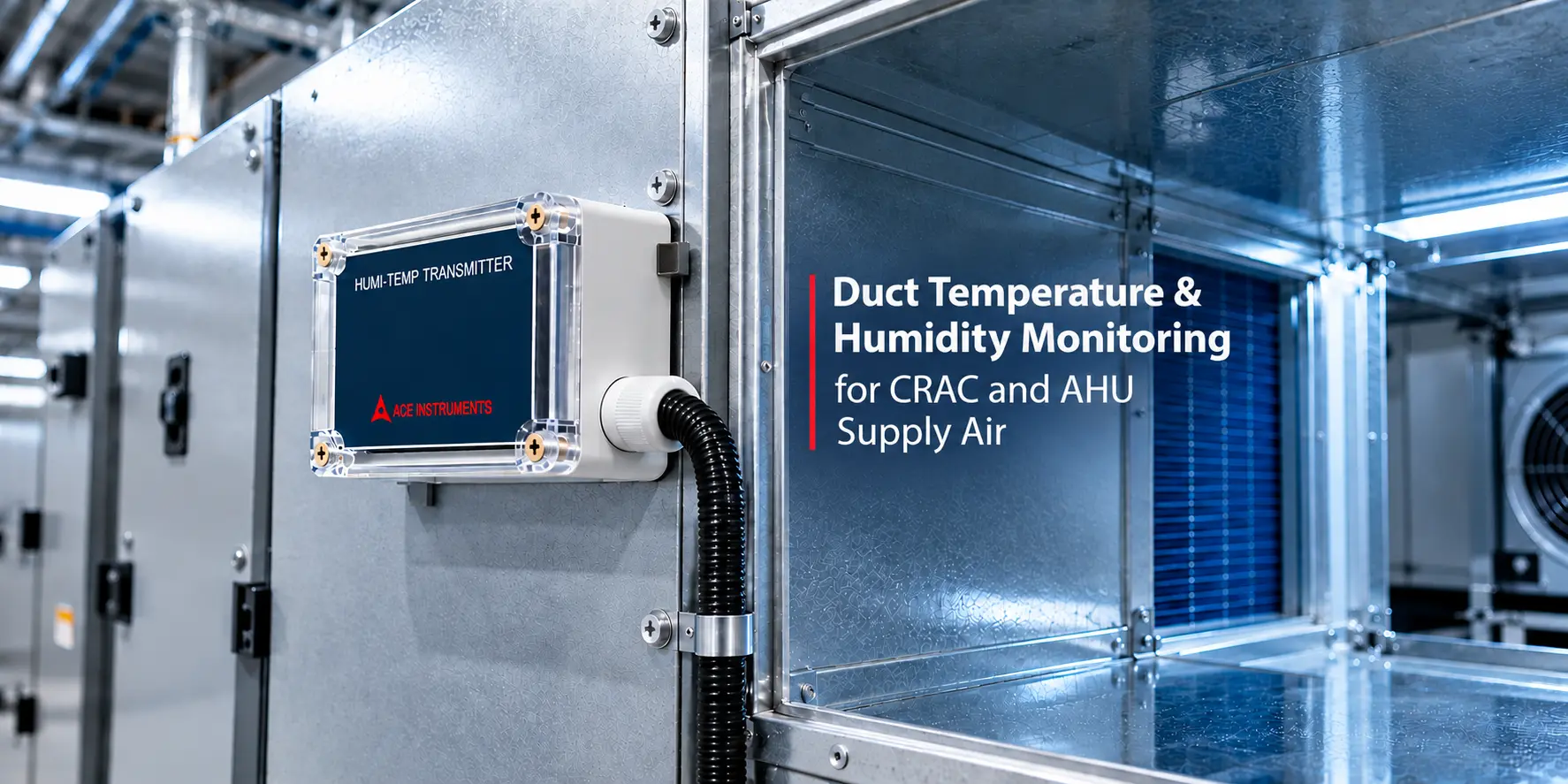
The AI-RHTx-D mounts directly in the supply duct downstream of the CRAC or AHU coil, giving a stable reading of the air actually being pushed into the white space before it mixes with anything else. Because the reading reflects the unit's own output rather than a downstream location affected by rack load or aisle containment performance, it is the more direct input for CRAC/AHU setpoint control and for detecting a coil or humidification fault at its source.
Output is available over 4-20mA, 0-10V, or RS-485 Modbus RTU, so the same duct reading can drive both local unit control and BMS-level trending without a separate instrument for each purpose.
Field Note
A facilities team troubleshooting inconsistent cold aisle temperatures across a data hall initially suspected containment leakage. Duct-mounted AI-RHTx-D readings at each CRAC discharge showed one unit was delivering supply air nearly 4°C warmer than its neighbours, a failing coil, not a containment issue and the unit was pulled for service before it affected uptime.
Frequently Asked Questions
Why monitor temperature and humidity at the duct instead of at the rack?
A duct-mounted reading at the CRAC or AHU discharge shows exactly what the cooling unit is delivering, unaffected by bypass air or rack-level mixing, making it a more direct input for detecting a cooling unit fault at its source.
What supply air temperature range should a CRAC or AHU maintain?
ASHRAE TC 9.9 Class A2 guidance recommends a supply air temperature range of 18 - 27°C with relative humidity between 20% and 80% non-condensing for typical data centre equipment.
Where is the AI-RHTx-D installed?
The AI-RHTx-D is installed directly in the supply duct downstream of the CRAC or AHU coil, measuring conditions at the point of discharge rather than downstream at the rack.
Why Trust IAQ Detectors
The AI-RHTx-D duct temperature and humidity monitor is manufactured by Ace Instruments under CE certification and ISO 9001:2015; IAQ Detectors instrumentation supports CRAC and AHU monitoring across more than 1,000 commercial and industrial installations worldwide.
Know the latest trends in IAQ solutions from the Ace Instruments team


Get inspired and learn more
Instruments that exceed your technical expectations
Comprehensive and customized IAQ solutions for all applications

