
Duct-Mounted Air Quality Transmitters: The Complete Guide for HVAC and BMS Engineers
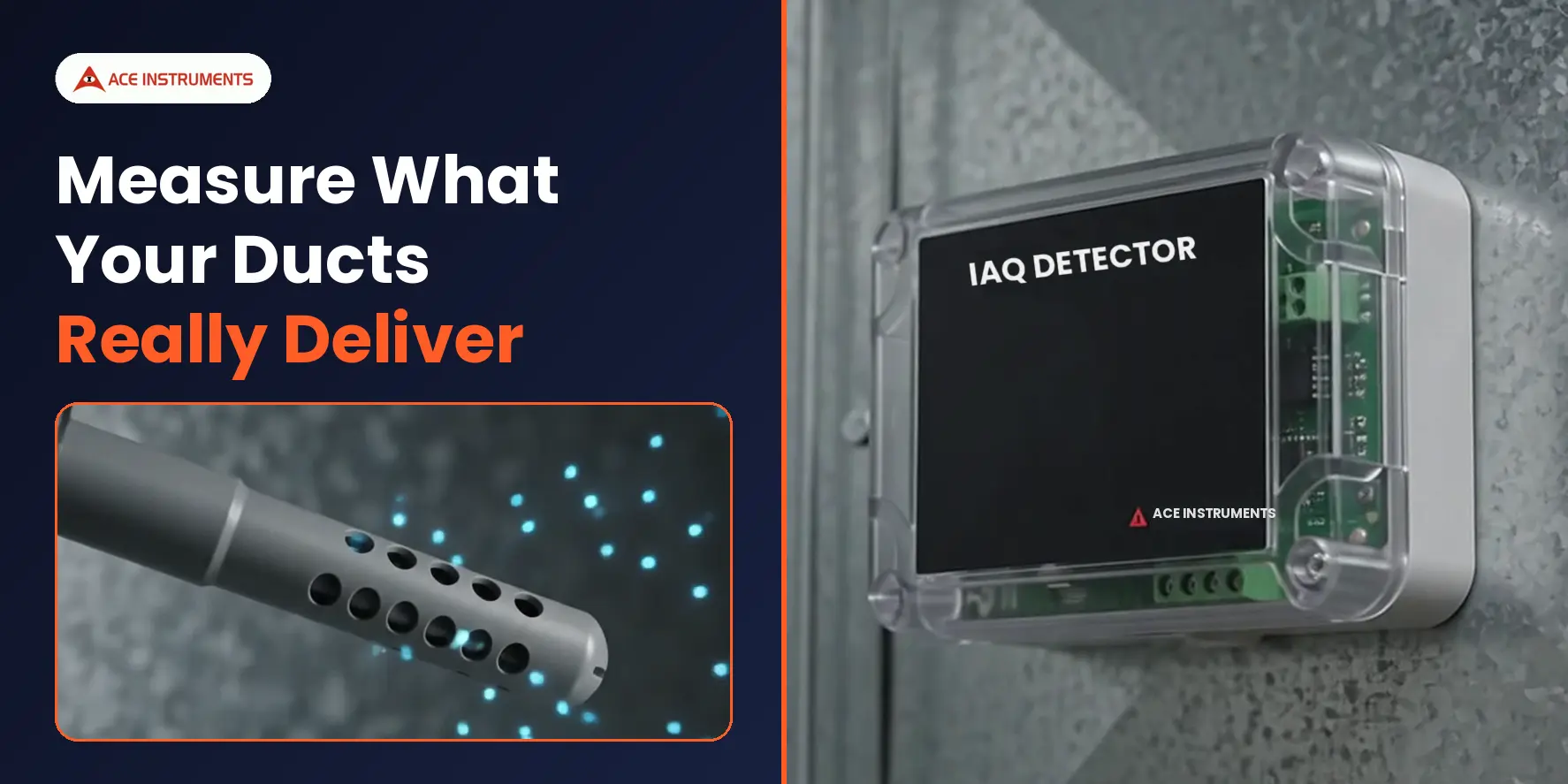
A duct-mounted air quality transmitter is an instrument installed in an air handling unit or ductwork that measures a parameter of the moving airstream, such as CO2, VOC, particulate matter, temperature or humidity, and sends that value to the building management system (BMS) for control. Room monitors tell you what occupants breathe; duct transmitters tell you what the HVAC system is delivering, removing or recirculating.
This guide covers the full IAQ Detectors duct range from Ace Instruments: what each transmitter measures, where it belongs in the air path, how it connects to a BMS, and which standards drive the requirement. Each section links to a deeper article in this cluster.
The IAQ Detectors duct range at a glance
| Parameter | Model | Typical duct location | Primary control use | Key reference |
|---|---|---|---|---|
| CO2 | AI-CO2-D | Return air | Demand-controlled ventilation | ASHRAE 62.1-2022 |
| VOC | AI-VOC-DT | Outdoor intake, return, exhaust | Outdoor air lockout, purge | WELL v2 A01 (TVOC ≤500 µg/m³) |
| PM2.5 / PM10 | AI-PM-DT | Downstream of filters, outdoor intake | Filter verification | WHO 2021 AQG, ISO 16890 |
| Temperature / RH | AI-RHTx-D | Supply, return, after coil | Coil and humidity control | ASHRAE 55-2023 |
| Carbon monoxide | AI-CO-D | Car park exhaust, outdoor intake | Exhaust fan staging | WHO, OSHA 50 ppm TWA |
| Static pressure | AI-DP-S | Two-thirds down main supply duct | VFD fan speed control | ASHRAE 90.1 |
| Multi-parameter IAQ | AI-IAQ-D | Return air | Single-point IAQ overview | WELL v2, LEED v4.1 |
Why measure in the duct at all?
Duct measurement answers three questions that room monitors cannot. First, what is the AHU actually supplying, after filters and coils? Second, what is the blended condition of all the zones the unit serves, as seen in the return? Third, what is coming in from outside before it reaches occupants? These answers let a BMS control fans, dampers, coils and humidifiers directly from the variable that matters.
Duct transmitters also reduce installation and maintenance cost on large floor plates. One return-air CO2 transmitter can drive ventilation for a single-zone AHU that would otherwise need several wall units. The
trade-off, covered in duct-mounted vs wall-mounted monitoring, is that a duct reading is an average and can hide a crowded meeting room.
How duct transmitters measure a moving airstream
Each parameter uses a different measurement principle. CO2 is measured optically by infrared absorption. Particulate matter is measured by laser scattering using a Swiss detection element. VOCs are detected as a total VOC signal using a Swiss detection element. Carbon monoxide uses a Japanese electrochemical cell. Temperature and humidity use a combined probe inserted into the airstream.
Airflow is the common challenge. Velocity, turbulence and stratification all affect what the probe sees. Our article on laser scattering in a moving airstream explains this for particulate matter, and the duct transmitter installation guide covers straight runs, probe depth and stratification for every parameter.
Where each transmitter belongs in the air path
Location decides what the reading means. CO2 belongs in the return, because that is where occupant-generated CO2 is concentrated. PM belongs downstream of the final filter to verify filtration, and at the outdoor intake to measure the load on it. Temperature and humidity belong after the cooling coil and in the supply duct. The full logic is set out in supply, return, exhaust or outdoor air.
Connecting duct transmitters to a BMS
The IAQ Detectors duct range offers RS-485 Modbus RTU and analogue 4–20mA and 0–10V outputs. Analogue suits a single control loop wired to a DDC controller; Modbus RTU suits multi-parameter instruments and long daisy-chained runs. See choosing outputs for duct transmitters for wiring limits and selection rules.
Field note
In a six-AHU commercial office in Hyderabad, the facilities team had wall CO2 monitors on two floors and nothing on the remaining four. Adding an AI-CO2-D in each return duct gave the BMS a ventilation signal for every unit within one shutdown weekend, with no ceiling work in occupied areas. Wall monitors were kept in the two large conference suites, where return-air averaging would otherwise have masked peak occupancy.
Frequently asked questions
What is a duct-mounted air quality transmitter?
A duct-mounted air quality transmitter is an instrument mounted on HVAC ductwork that measures a parameter of the airstream and outputs it to a BMS. Common parameters are CO2, VOC, PM2.5/PM10, temperature, humidity, carbon monoxide and static pressure.
Should CO2 be measured in the supply or the return duct?
CO2 should be measured in the return duct, because that is where occupant-generated CO2 accumulates. Supply air is diluted with outdoor air and will always read lower than the occupied space.
Can one duct transmitter replace room monitors?
One duct transmitter can replace room monitors only for single-zone systems with even occupancy. For multi-zone AHUs or spaces with variable occupancy such as conference rooms, combine a return-air transmitter with room monitors such as the AI-IAQ6-PH.
What outputs do IAQ Detectors duct transmitters provide?
IAQ Detectors duct transmitters provide RS-485 Modbus RTU and analogue 4–20mA or 0–10V outputs, depending on model. Check each product datasheet for the output options available on that model.
Which standards require duct air quality monitoring?
No single standard mandates duct monitoring, but ASHRAE 62.1-2022 permits demand-controlled ventilation based on CO2, LEED v4.1 requires outdoor airflow monitoring, and WELL v2 sets indoor air thresholds that duct data helps maintain.
Why engineers specify Ace Instruments
Ace Instruments has designed and manufactured air quality and environmental instrumentation in Hyderabad since 1991, from a 10,000 sq.ft facility, with more than 1,000 installations worldwide. Every IAQ Detectors instrument is CE certified and built under an ISO 9001:2015 quality management system, using Swiss detection elements for VOC and particulate matter and Japanese electrochemical cells for carbon monoxide. The duct range shares one housing family and one set of output options, so a single BMS points schedule covers every parameter. To specify duct-mounted monitoring for your next project, contact the IAQ Detectors team for datasheets and application support.
Know the latest trends in IAQ solutions from the Ace Instruments team


Get inspired and learn more
Instruments that exceed your technical expectations
Comprehensive and customized IAQ solutions for all applications

