


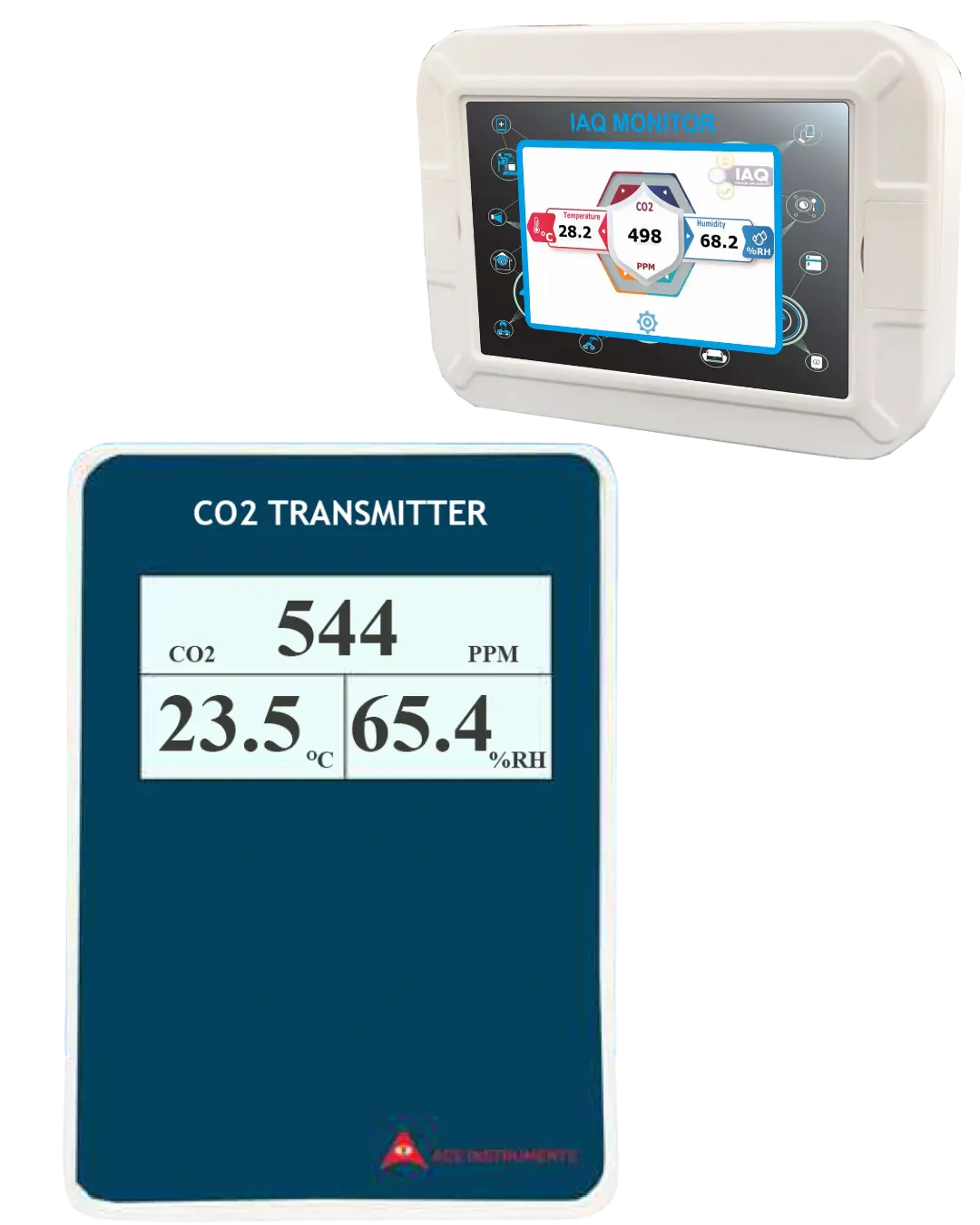
Description
The AI-CO2-IAQ measures the critical parameters of carbon dioxide temperature and humidity. Manufactured by Ace Instruments, it allows for greater control over indoor air quality via CO2 and temperature + humidity measurement in one solution. It is ideal for CO2, humidity and temperature monitoring in commercial buildings such as schools, offices, hotels, and public assembly areas. It finds industrial application in monitoring of cold storages and warehouses. Optional RS-485 Modbus communication provided for BMS/EMS connection.
Features
- Fast response photoacoustic sensor (Switzerland)
- Optional RS-485 communication
- ABS plastic wall mounting enclosure
- Optional touchscreen display or GLCD display
What It Measures
- CO₂ Concentration: Measures carbon dioxide levels in parts per million (ppm), a key indicator of ventilation adequacy and indoor air quality
- Temperature: Continuous ambient temperature monitoring for occupant comfort and equipment protection
- Relative Humidity (RH): Tracks moisture levels to prevent mold growth, static buildup, and material degradation
Together, these three readings give a complete picture of occupied-space air quality - CO₂ signals how well a space is ventilated, while temperature and humidity indicate overall comfort and environmental stability.
Why Monitor CO₂ and T/RH Together
CO₂ indicates ventilation adequacy: rising levels signal that fresh air exchange isn't keeping pace with occupancy. Temperature and humidity determine thermal comfort, shaping how occupants actually experience a space regardless of how well it's ventilated. Together, they give the BMS everything it needs to maintain occupant comfort from a single wiring point, instead of reconciling data from three separate instruments on three separate addresses.
Applications
CO₂ buildup in guest rooms and lobbies signals when fresh air isn't keeping pace with occupancy, helping maintain guest comfort without over-ventilating and wasting energy.
Open-plan floors and meeting rooms see sharp CO₂ swings as headcount changes through the day; continuous monitoring lets HVAC respond to actual occupancy rather than a fixed schedule.
Patient rooms and waiting areas need tight control over both air quality and thermal comfort, where elevated CO₂ or humidity can affect recovery conditions and infection control.
Different zones in a building rarely have the same occupancy or load; per-zone CO₂ and T/RH data supports demand-controlled ventilation instead of one-size-fits-all airflow.
BMS Integration
RS-485 Modbus communication lets the AI-CO2-IAQ report all three parameters through a single address, reducing wiring complexity and point count on the BMS. A programmable buzzer alarm with configurable set points flags out-of-range conditions locally, while the 128x64 graphic backlit display (touchscreen optional) shows live CO₂, temperature, and humidity readings alongside alarm limits, date, and time.
Frequently Asked Questions:
1. What is the AI-CO2-IAQ 3-in-1 Wall Sensor?
The AI-CO2-IAQ is a wall-mounted indoor air quality monitor that simultaneously measures Carbon Dioxide (CO₂), Temperature, and Relative Humidity. It provides real-time environmental monitoring to help maintain healthy, comfortable, and energy-efficient indoor spaces.
2. Why should I monitor Carbon Dioxide (CO₂) levels indoors?
CO₂ is an important indicator of ventilation quality. Elevated CO₂ levels can lead to drowsiness, headaches, reduced concentration, and discomfort. Monitoring CO₂ helps ensure adequate fresh air circulation and supports healthier indoor environments.
3. Why are temperature and humidity monitored along with CO₂?
Indoor comfort and air quality depend on more than just CO₂. Temperature and humidity affect occupant comfort, equipment performance, and product quality. Monitoring all three parameters together provides a complete picture of the indoor environment.
4. Where can the AI-CO2-IAQ be installed?
The AI-CO2-IAQ is ideal for offices, conference rooms, classrooms, hospitals, laboratories, pharmaceutical facilities, cleanrooms, hotels, shopping malls, airports, commercial buildings, and manufacturing facilities.
5. How does monitoring CO₂ improve energy efficiency?
Instead of running ventilation systems continuously, CO₂ levels can be used to control fresh air supply based on occupancy. This demand-controlled ventilation approach reduces HVAC energy consumption while maintaining healthy indoor air quality.
6. What does the AI-CO2-IAQ measure?
The monitor continuously measures Carbon Dioxide (CO₂), Temperature, and Relative Humidity. These parameters are displayed in real time and can also be transmitted to Building Management Systems (BMS).
7. Is the sensor suitable for continuous operation?
Yes. The AI-CO2-IAQ is designed for continuous 24×7 monitoring in commercial, healthcare, pharmaceutical, educational, and industrial environments.
8. Can it be integrated with a Building Management System (BMS)?
Yes. The AI-CO2-IAQ supports RS-485 Modbus communication, allowing seamless integration with BMS, SCADA, HVAC controllers, and other building automation systems.
9. What type of CO₂ sensor is used?
The AI-CO2-IAQ uses a high-quality photoacoustic CO₂ sensor, known for its excellent accuracy, long-term stability, and minimal maintenance requirements.
10. Does the monitor help improve indoor air quality?
Yes. By continuously monitoring CO₂, temperature, and humidity, facility managers can take timely corrective actions such as increasing ventilation or adjusting HVAC settings to maintain healthy indoor conditions.
11. Can the monitor trigger alarms?
Yes. Depending on the model and system configuration, alarm outputs or relay functions can be provided to alert users when CO₂, temperature, or humidity exceed predefined limits.
12. Is the AI-CO2-IAQ suitable for pharmaceutical and healthcare applications?
Yes. It is widely used in pharmaceutical manufacturing, hospitals, laboratories, and other controlled environments where monitoring indoor environmental conditions is important for compliance, safety, and occupant comfort.
13. Does the monitor store historical data?
The standard device provides real-time monitoring. Historical data can be recorded when connected to compatible Building Management Systems, SCADA platforms, or data logging software.
14. Is the device easy to install?
Yes. The compact wall-mounted design allows quick installation in occupied spaces without requiring complex modifications.
15. How often should the sensor be calibrated?
Calibration frequency depends on the application and quality requirements. Periodic calibration is recommended to ensure continued measurement accuracy. Ace Instruments also provides calibration support and calibration certificates upon request.
16. What are the benefits of using a 3-in-1 monitor instead of separate sensors?
A single device monitors three critical parameters simultaneously, simplifies installation, reduces wiring costs, saves wall space, lowers maintenance requirements, and provides a comprehensive view of indoor air quality.
17. Who typically uses the AI-CO2-IAQ?
The monitor is widely used by facility managers, HVAC engineers, building automation integrators, pharmaceutical QA teams, hospital engineering departments, cleanroom consultants, maintenance engineers, and energy managers.
18. Can the AI-CO2-IAQ help achieve green building certifications?
Yes. Continuous monitoring of indoor environmental conditions supports building performance initiatives and can contribute to compliance with standards such as WELL, LEED, GRIHA, and other sustainable building programs where indoor air quality monitoring is required.
19. Why choose Ace Instruments?
Ace Instruments has been manufacturing environmental monitoring solutions since 1991. Customers trust Ace for high-accuracy sensors, industrial-grade reliability, easy BMS integration, customizable solutions, calibration support, responsive technical assistance, and proven installations across pharmaceutical, healthcare, HVAC, commercial, and industrial sectors.
20. How do I choose the right CO₂ monitor for my application?
Our application engineers can recommend the most suitable AI-CO2-IAQ configuration based on your facility type, occupancy levels, communication requirements, monitoring objectives, and integration needs.
Specifications
Gain insight into your IAQ solution and know technical specifications

